


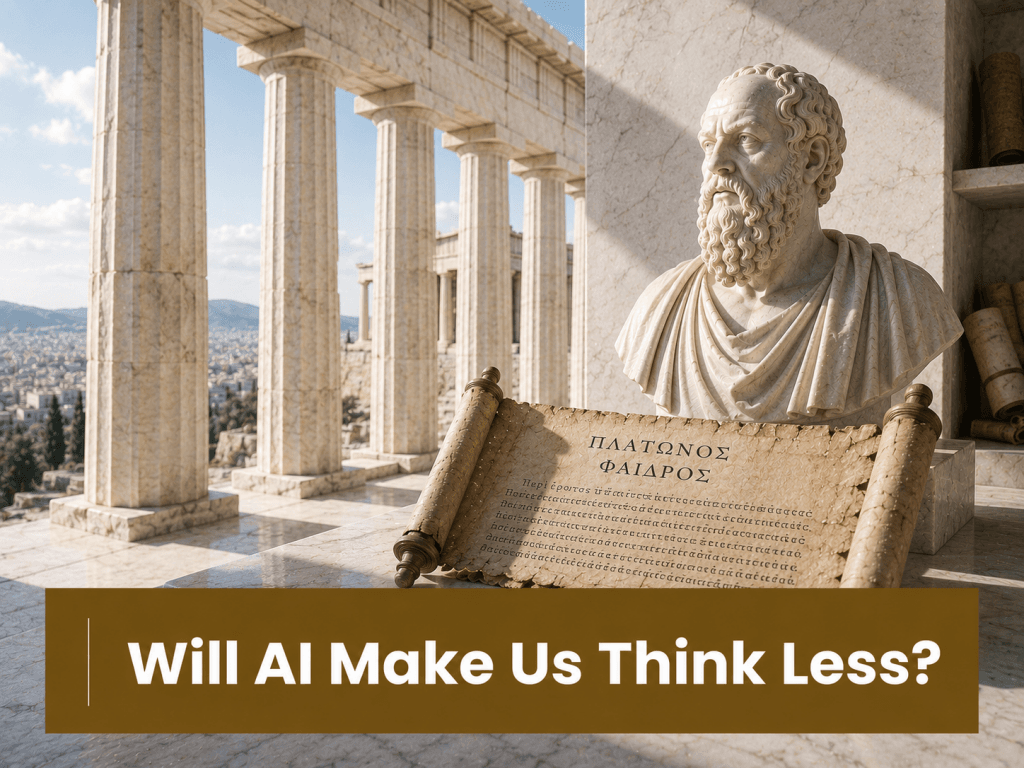
Around 2,400 years ago, in Plato’s dialogue Phaedrus, Socrates tells a story about a new technology.
In ancient Egypt, the god Theuth invented a number of arts and disciplines: arithmetic, geometry, astronomy, games — and writing. He went to King Thamus to present his inventions and explain the benefit each one would bring.
Theuth praised writing in particular. It would make the Egyptians wiser, he argued, and improve their memory. Knowledge could now be preserved outside the human mind, revisited later and passed on to others.
Thamus was less impressed.
As its inventor, Thamus tells Theuth, he is too fond of his own creation to judge its consequences impartially. Writing will not strengthen memory. People will exercise their memory less because they will be able to rely on external marks instead.
But memory was only part of his objection. Thamus was concerned about something more serious: people would be able to read a great deal and appear knowledgeable without necessarily gaining genuine understanding. They would acquire the appearance of wisdom rather than wisdom itself.
That argument survives in Plato’s Phaedrus, 274c–275b.
There is a historical irony here. We know about this warning against writing largely because Plato wrote it down. The technology being questioned in the text preserved the argument itself for more than two thousand years.
Behind that irony lies a question that has outlived the age in which it was first posed.
What happens to a human ability when a new technology makes that ability increasingly unnecessary?
The Same Argument, 2,400 Years Later
Now bring the argument forward to 2026.
An AI advocate might say that people no longer need to search through twenty sources, read them one by one, compare their arguments and spend hours producing an initial synthesis. AI can do much of that work in minutes, freeing human time for more demanding tasks.
A critic might answer almost exactly as Thamus did: that is precisely why people will gradually lose the ability to find sources, compare arguments and form conclusions for themselves.
At its core, the same intellectual conflict has resurfaced roughly 2,400 years later. When technology relieves us of part of our mental work, does it extend our capabilities — or gradually weaken the ability whose work it has taken over?
The history of writing shows why we cannot simply assume the second answer.
Writing did reduce the need to hold vast amounts of information entirely in human memory. In that sense, Thamus’s concern was perfectly understandable. At the same time, writing allowed people to work with accumulated knowledge on a scale that no individual mind could possibly retain.
A philosopher could continue an argument with someone who had died centuries earlier. A scientist could build on observations made by people they had never met. Laws, theories, histories and artistic forms could outlive their creators and become material for the next generation.
We lost some of the need to remember and gained the ability to think across a far larger body of preserved knowledge.
A reduced need to perform a particular cognitive task therefore does not, by itself, amount to intellectual decline. Sometimes it creates the conditions for more complex forms of intellectual work.
We Have Been Handing Things Over for a Long Time
Writing was only the first step.
The printing press shifted to technology a task that had previously demanded enormous human labour: reproducing knowledge at scale. An idea no longer had to be copied by hand again and again in order to outlive its author and reach another reader.
The mass press took on a different function. It began deciding what mattered and explaining events to its audience. Readers received an editorially assembled picture of the day: what deserved the front page, what was secondary and what context should shape the way events were understood.
Radio and television went further. Information acquired voice, intonation, images and movement. Events no longer reached people only as words they had to picture for themselves; they arrived already narrated, visualised and framed for the audience. At the same time, a relatively small number of sources gained enormous power to shape how mass audiences understood the world. The side effects grew with that power: concentrated influence, manipulation and propaganda.
The internet made vast amounts of information available to almost anyone. Alongside useful information, people gained equally easy access to misinformation, fraud, illegal material, extremist content and other dangerous consequences of information freedom.
Search engines took the next step. Within all that available information, they took over the search for and preliminary selection of what appeared most relevant to a user’s query.
Over several centuries, we gradually handed external systems more of the work involved in dealing with knowledge: preserving and reproducing it, deciding what mattered and explaining events, shaping how information was presented, making it widely accessible and, eventually, finding and pre-selecting what was relevant.
Societies did not always adapt smoothly or quickly. Over time, however, new media were surrounded by regulation, professional standards, new forms of education and new skills for evaluating information. We learned to preserve many of the benefits while trying to contain at least some of the harms.
AI continues this historical trajectory.
Only now, we are handing over something else.
What Is AI Actually Taking Over?
The idea that AI is the first technology to analyse information on our behalf is historically wrong.
A book could already represent years of someone else’s analysis. A newspaper interpreted events. Television constructed narratives about what was happening. The internet gave us reviews, rankings, encyclopaedias, expert articles and ready-made summaries on almost any subject.
We have long relied on the results of other people’s thinking.
Previously, that synthesis usually had a visible author or institution behind it. We read a particular journalist, a particular researcher’s book or the work of a particular editorial team.
AI can assemble an answer dynamically, specifically in response to our question. It can find material, select relevant passages, compare claims and combine them into a coherent response.
A generative system also produces new text of its own. It can add connective explanations, interpretations, inferences and factual claims that do not appear in any single source. Some of them may be wrong.
And the original sources are not necessarily reliable either. They may be weak, biased, outdated or deliberately manipulative. AI can faithfully summarise a poor source, misunderstand a good one or introduce an error during generation.
The result is a newly generated answer in which source material, other people’s interpretations and machine-generated content may all be fused into one confident-sounding response.
Search engines largely decided what to show us.
AI increasingly participates in determining how those materials become a conclusion.
That changes the kind of intellectual work we can hand over.
Cognitive Offloading Is Not New
Psychologists have long studied a phenomenon known as cognitive offloading — using an external action or tool to reduce internal cognitive demands.
We write down a phone number instead of holding it in memory. We make shopping lists. We set reminders. We use calendars. In their classic 2016 review, Evan Risko and Sam Gilbert describe cognitive offloading as the use of physical action to reduce the cognitive demands of a task.
This is not, in itself, evidence of intellectual decline.
Nearly a decade later, Lauren L. Richmond and Ryan G. Taylor examined the benefits and potential costs of such offloading in Nature Reviews Psychology. Their 2025 review presents a more complicated picture: offloading can improve task performance, but it can also create costs. For example, unexpectedly losing access to information stored externally can leave someone performing worse than if they had relied on their own memory from the beginning.
A more recent 2026 discussion in Trends in Cognitive Sciences makes the concern more specific: offloading cognitive work to AI may impede skill acquisition and contribute to skill decay, although the risk depends on how AI is used.
With AI, cognitive offloading begins to encompass stages of reasoning itself: comparison, interpretation and the formation of preliminary conclusions.
This is where the analogy with writing begins to help us — and also where it starts to mislead.
AI Is Not Just Another Book
In Phaedrus, Socrates points to another curious limitation of written text: you cannot truly question it.
A text does not notice that its reader has misunderstood something, change its explanation or respond to an objection. Ask the written word a question, Socrates says, and it simply keeps saying the same thing.
AI can be questioned. You can ask it to explain something more simply, challenge it, ask it to compare two positions, produce a counterargument or continue the investigation in a different direction.
That makes AI a far more active intellectual intermediary than ordinary text.
A book preserves an argument. AI can participate in constructing one. A text presents an author’s position. AI can help determine which positions a user sees in the first place and how those positions are connected.
This gives AI enormous potential as a tool for thought. For the same reason, it can intervene more deeply in processes that once took place inside the human mind.
The history of writing therefore offers no easy reassurance that “people were afraid of that technology too, and everything turned out fine”.
It offers a more modest lesson. Handing cognitive work to an external tool is not, by itself, proof of intellectual decline. But the work we are now handing to AI reaches much closer to the formation of judgement itself.
So is that beginning to change the way we think?
Are We Already Thinking Differently?
We do not yet have enough evidence to say that AI is making people less intelligent. That would require long-term research capable of tracking actual changes in human abilities over time.
Early research does suggest something else: AI may be changing where people apply their intellectual effort.
In the Microsoft Research study The Impact of Generative AI on Critical Thinking, 319 knowledge workers described 936 real-world examples of using generative AI. Greater confidence in AI’s ability to perform a task was associated with less self-reported critical thinking. The researchers also observed a shift in the nature of that work, with more attention moving towards verification, integration and stewardship — checking the output, incorporating it into one’s own work and overseeing the process.
That is more interesting than simply asking whether we are “thinking less”.
Much of the intellectual effort used to come at the beginning of a task: finding material, reading several sources, understanding the differences between them and assembling an initial answer.
AI can take over much of that stage.
A person can now begin with something that already looks like a finished intellectual construction. Their effort may then shift later in the process: deciding whether that construction is reliable, what it leaves out and whether its conclusions actually follow from the evidence.
Instead of asking:
“How do I build the answer?”
we may increasingly find ourselves asking:
“Should I accept the answer that has already been built for me?”
There is an important qualification.
The intellectual effort does not automatically move to the next stage. It can move there if the person checks, challenges and continues the inquiry.
Or it can simply disappear from the process if the ready-made answer feels good enough.
And this is where the most serious problem in the story emerges.
Verification Has a Hidden Requirement
It is easy to say that AI can always be checked.
Actually doing so is much harder.
Opening the cited link is not enough to verify an AI answer. The source itself may be poor. Its reasoning may be weak. Several accurate facts can be combined into a conclusion that does not follow from them. The system can add a claim that appears nowhere in the source material or present uncertain evidence with far more confidence than it deserves.
Recognising these problems requires judgement of our own.
We need to understand what a strong argument looks like and where it can fail. We need to evaluate the quality of evidence and notice when persuasive language begins to substitute for a persuasive case.
And here we reach a paradox.
The more analytical work we hand over to AI, the more important our ability to judge that work becomes.
But judgement develops through practice.
If people spend less time finding sources for themselves, comparing positions, constructing arguments and forming conclusions, they may also get less practice in exactly the activities required to evaluate AI.
This creates a loop: the tool relieves us of a skill, yet safe use of the tool still depends on that skill.
In routine, low-stakes tasks, this may barely matter. A mistake in an email summary or a less-than-perfect recommendation is unlikely to change someone’s life.
As the stakes rise, the loop becomes much less comfortable.
The central risk is that errors may become harder for us to recognise precisely because we are practising less of the intellectual work required to recognise them.
What Could We Do With the Capacity We Free Up?
There is another side to that paradox.
Suppose a researcher once needed two hours to find ten suitable sources, read them and build an initial map of a problem. AI reduces that stage to twenty minutes.
The researcher can accept the resulting summary and stop there.
Or the remaining time can be spent on work that was previously harder to reach: investigating contradictions between sources, exposing hidden assumptions, developing alternative explanations, looking for missing evidence and generating new hypotheses.
The cognitive effort saved then becomes a resource for more demanding cognitive work.
What matters is the kind of work that fills the space AI has freed.
Over time, our idea of the most valuable intellectual abilities may also change. If search and initial summarisation become almost instantaneous, greater value may shift towards recognising a missing argument, working with uncertainty, asking a better question or generating a hypothesis that was absent from the original set of possibilities.
We do not yet know what new forms of research, creativity or problem-solving may emerge from that foundation.
For one person, an AI answer may be where the thinking ends. For another, the same answer may be where the harder thinking begins.
And that brings us back to the old argument.
An Old Argument, Today’s Choice
Around 2,400 years later, the question Socrates raised sounds remarkably contemporary. Only now, technology is taking on far more than memory.
It already plays a role in storing and finding information, and that role is extending deeper into comparison, interpretation and the formation of conclusions.
That is why its greatest advantage is so closely tied to its greatest risk.
AI can free up increasing amounts of time and intellectual space. At the same time, our ability to recognise when an answer deserves our trust — and when it should be challenged — becomes more important.
That leaves each of us with a choice about what to do with the time and attention AI frees. Used for deeper questions, stronger verification, new ideas and more difficult problems, that capacity may expand what we are able to think through. If a convincingly phrased ready-made answer becomes enough, parts of our own analytical process may gradually become less necessary — and perhaps less developed as a result.
So the question Will AI Make Us Think Less? has no single answer.
Two people can ask AI the same question tonight. One will take the answer and close the tab. The other will still be arguing with the answer tomorrow.


