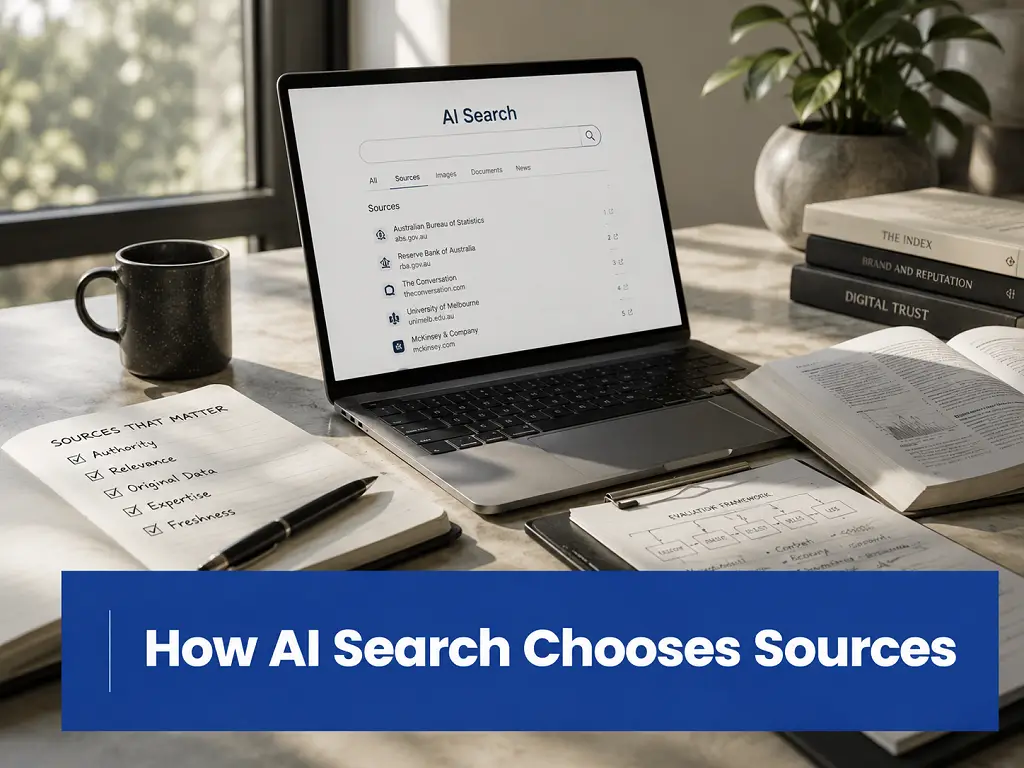
When we read an AI-generated answer and look at the sources shown beside it, it is easy to assume that the whole answer was built from those pages. But if you regularly open those links and compare them with the answer, you start to notice something odd: some of the information in the answer is not there at all. In other cases, a source supports only one small part of a much broader response.
For a business, this matters because there is a long path between publishing information online and seeing that information appear in an AI answer. A source may be discovered, accessed, retrieved, used, and cited — and each stage involves a different kind of selection.
This Article Is for You If You’re Asking:
- Why does AI mention my competitors but not my business?
- Why can my website be visible in search but still missing from AI answers?
- What actually has to happen before AI can use my business as a source?
Before Choosing Sources, AI Has to Understand the Question
Not all information in an AI answer is necessarily found on the web at the moment the user asks a question. The model already has knowledge from its training, and when needed it may combine that with web search, connected documents, databases, or other available sources. This is one reason visible citations do not always reveal the full information base behind an answer.
Before AI can choose a source, it first has to work out what information it needs. Imagine someone asks:
What is the best accounting software for a small business in Melbourne?
Finding pages that mention accounting software is only the beginning. The system also has to understand what the user is trying to achieve, take location into account, decide how current the information needs to be, and identify the product features that matter in that context. One question may effectively turn into several smaller information needs.
For a business, the more useful starting point is a different question:
Which customer questions do I want my business to be a source for?
A Source Has to Pass Several Stages
A simple way to think about the path from a web page to an AI answer is:
discovered → accessible → retrieved → used → cited
This framework is a simplified way to understand the process. Different AI systems may handle these stages differently, and some of them may happen earlier, for example during indexing.
The important point is that several barriers sit between published information and a visible citation. The source has to be known to the system, its content has to be reachable, it has to match the current information need, and something in it has to be useful enough to influence the answer. Citation comes later, and it is not guaranteed.
This explains why a website can exist, be indexed, contain accurate information, and still fail to appear in AI answers.
First, the Source Has to Be Discovered and Accessible
Discovery and access are separate issues. A system may know that a page exists but be unable to retrieve its content. A page may also be technically accessible yet remain largely invisible to the systems that might otherwise use it.
From a business owner’s point of view, both situations produce the same visible result: the company does not appear. The underlying causes, however, are very different. One may involve technical access, while another may involve how and where the business is being discovered.
Even after both conditions are met, the source is still only a candidate. There may be hundreds or thousands of accessible pages related to the same subject, so the system still has to decide which ones are useful for the specific question being asked.
Then the Source Has to Be Retrieved
At the retrieval stage, the question becomes:
Does this source contain the information needed for this particular task?
The answer depends heavily on context. If someone asks about a law that changed yesterday, freshness may be critical. For a medical question, a recognised medical organisation or relevant study may carry more weight. A manufacturer can be the strongest source for a technical specification, while independent reviews may be more useful for a question about everyday use.
The key point is that source quality is relative to the claim being answered. A source that is excellent for one part of an answer may be weak for another.
For a business, this means broad authority alone is not enough. The information also has to fit the kinds of questions the business wants to appear for.
One Answer Can Need Different Sources
A single AI answer may draw on different kinds of sources for different parts of the response.
Suppose someone asks whether a particular university is a good choice for an international student. The university website may provide tuition fees and admission requirements. An independent source may offer comparative data, while student reviews may help explain the real experience of studying there.
Each source is useful for a different reason. This means businesses do not always compete at the level of entire websites. Often, what matters is whether a specific fact, claim, or piece of information is useful for one part of the answer.
That changes the practical goal. A business does not need to become the dominant source for an entire subject. It may be far more valuable to become a strong source for a specific question or for a specific part of an answer.
Retrieved Does Not Mean Used
Even when a source is retrieved, its information may never appear in the final answer. The system may compare several documents, ignore some of them, or use only small parts of what it finds.
This is difficult to observe from the outside. A company may have been discovered, its pages may be accessible, and its content may even be relevant, yet the user still sees no sign of it in the final response.
That is why a test such as “I asked ChatGPT and my company was not there” tells you very little about the cause. It shows the outcome, but not the point at which the source stopped progressing through the process.
Used Does Not Mean Cited
Even information that influences an answer may not receive a visible citation. This brings us back to the observation from the beginning: sometimes the listed sources do not appear to contain everything the answer says.
The final response can be based on a mixture of retrieved information and other information available to the system, while the visible citations represent only part of that foundation.
For AI visibility analysis, this creates an important limitation. A missing citation does not prove that a source was never seen or used, and a single citation does not prove that the site has become a preferred source on the topic. Citations are useful signals, but they need to be interpreted carefully.
Different Stages Use Different Criteria
The requirements change as a source moves through the process. Early on, the main challenge is simply being found and having content that the system can reach. Later, relevance becomes more important: does the source actually contain what is needed for this question?
Even then, useful information may still be left out of the answer, and citation adds another layer of judgement about which source is appropriate to show the user. A technical fix may therefore solve one problem while leaving another untouched. Freshness can be crucial for one query and almost irrelevant for another, while the same source may be strong evidence for one claim and weak evidence for the next.
Source selection is a process with different requirements at different stages.
What This Means for Your Business
Once you see source selection this way, AI visibility stops looking like a simple ranking problem.
A business can be absent from an answer for very different reasons. Sometimes the issue is technical or the relevant page is difficult to discover. In other cases, the content does not answer the questions customers are asking clearly enough. The wider information environment can matter too, especially when other sources describe the business differently or provide stronger evidence.
The useful task is therefore to understand why a business appears in some situations and disappears in others. A meaningful AI Search review should begin with the questions a business wants to be associated with, then work backwards through the information environment to identify where its information loses the chance to become part of the answer.
And that information environment extends far beyond the company’s own website. AI may encounter information about a business across many different sources, which raises another important question: what information is it actually finding about your company, and how reliable is it? That is what we explore next in Where Does AI Get Information About Your Business — and Why Can It Get It Wrong?