Imagine a simple situation. You ask ChatGPT, Gemini, or another AI system about your company. It knows the business name, can find information about it, understands what you do, and can describe your services fairly accurately.
Then you ask a different question:
“Which companies in Melbourne would you recommend for this service?”
And your business is not in the answer.
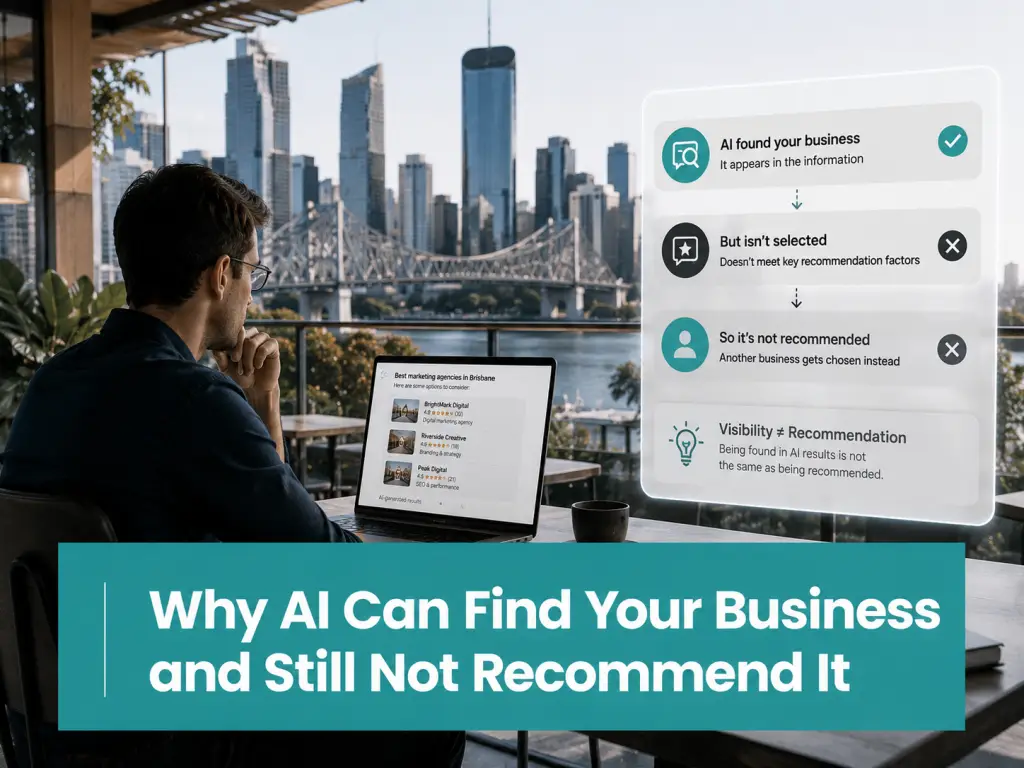
At first, this can seem strange. If AI knows your company and can find information about it, why does it not recommend it?
Because being found and being selected for an answer are different things.
This article is for you if you are asking:
- Why does AI know about my business but still not recommend it?
- Why do competitors appear in AI answers when my company does not?
- Why can AI cite my website without mentioning my business?
- Why is my business sometimes mentioned but not recommended?
- What should I improve if AI already knows my company exists?
These questions point to the same underlying issue: AI visibility is not a single state. A business can be visible in one part of the process and still disappear before the final answer reaches the user.
Being found is only the beginning
When AI answers a question, the process is not simply a matter of finding several websites and placing them in order.
In many AI Search systems, current information is first found or retrieved from available sources. This process is commonly called retrieval. The model then uses that information, together with the context available to it, to create the final response — generation.
For a business, the important distinction is simple: information about your company can be available to the system and may even contribute to an answer without your company name appearing in the final response.
That is why asking whether ChatGPT “knows” your business is useful only up to a point. The more important issue is whether the available information gives the system a clear reason to connect your business with the user’s specific request.
AI may know your business without understanding why it fits
Consider an accounting firm in Melbourne.
Its website says:
“We provide professional accounting and taxation services to businesses of all sizes.”
That may be enough to establish that it is an accounting firm.
But now someone asks:
“Who would you recommend for accounting services for a small restaurant in Melbourne?”
A broad category is no longer enough. For this question, the relevant connection is much more specific: does the firm work with restaurants, hospitality businesses, or similar small businesses?
If the website says little about that, the connection may not be clear.
A competitor, meanwhile, may have a dedicated page about accounting for cafés and restaurants, supported by relevant case studies and reviews from hospitality clients.
Both businesses may be known to the system. But one is much more clearly connected to the specific request.
At that point, the issue is no longer simply whether AI can find the company. What matters is how clearly the available information explains why that business is relevant to this particular customer.
Understanding the business may still not be enough
Suppose that connection is already clear.
The website explicitly says that the firm works with restaurants, cafés, and other hospitality businesses.
But AI still recommends competitors instead.
At this stage, the important question is how strongly that fit is supported.
One firm may mention its specialisation briefly on its own website. Another may reinforce the same positioning through dedicated service pages and case studies, while similar associations also appear in professional profiles, industry directories, reviews, or independent publications.
This does not mean there is a simple checklist of signals that automatically turns a company into a recommendation. Different AI systems use different sources and mechanisms, and much of their internal decision-making is not directly visible.
What does matter is the overall clarity of the information available about the business. A specialisation stated on a company website becomes more useful when the same positioning is also supported elsewhere.
This is also where another question becomes relevant: why do AI systems choose some sources and use them in answers while leaving others out? That is a separate issue, and one worth examining in its own right.
AI can use your website without recommending your business
There is another, less obvious situation.
A company publishes a useful article. An AI system uses it as a source when answering a user’s question. It may even show a link to that article.
It would be easy to assume that this should also improve the visibility of the business itself.
But that does not necessarily happen.
An AI system might use an accounting firm’s article to explain tax obligations for restaurants while naming completely different firms as businesses worth considering.
A page can contribute useful information to an answer without making the business itself a strong recommendation candidate.
An article may answer an informational question very well:
“What tax obligations does a restaurant have?”
But that article alone does not necessarily provide enough reason to conclude:
“This is the accounting firm you should choose.”
This is where the difference between information that was found or used and information that ultimately appeared in the generated answer becomes especially important.
Citation visibility therefore tells you something important, but it does not tell you whether the business itself is being recommended.
The reverse can also happen: the business is recommended, but the website is not cited
The opposite situation is possible too.
AI may name a company as a suitable option while relying on an industry directory, professional association, review, publication, or another source rather than the company’s own website.
That does not automatically mean there is a problem.
If the business goal is to enter a potential customer’s consideration set, being mentioned or recommended may matter more than which domain appears beside the answer.
However, if the company also wants referral traffic to its own site or wants that site to serve more often as a primary source, the question becomes different. The issue is then whether the website itself provides information that AI systems can use confidently and directly.
In other words, business visibility and website visibility are related, but they are not identical.
The same symptom can hide different problems
From a business owner’s perspective, all of this can look like one simple problem:
“AI does not recommend us.”
But the underlying cause can vary considerably.
Sometimes the positioning is too vague. In other cases, the specialisation is clear but poorly supported. A business may even contribute useful source material to AI answers and still remain largely absent from recommendations.
There are also cases where visibility already exists, just not in the form the owner expected. A company may be mentioned while its own site is not cited, or it may be cited without being presented as a recommendation.
That is why generic advice such as “add more pages”, “implement schema”, or “publish more content for ChatGPT” does not solve the underlying problem by itself.
The first step is to understand which kind of visibility the business is actually missing.
What you can check yourself
You do not need a complex technical audit for an initial check.
Start with realistic questions that potential customers might actually ask AI, rather than:
“Do you know company XYZ?”
Try questions such as:
“Which companies in Melbourne offer X?”
“Who would you recommend for Y?”
“Which specialists work with this type of business?”
Use several natural variations of the same underlying intent, and avoid drawing conclusions from a single answer.
Then look at who appears instead of you.
Pay attention to how those competitors are described, what qualities are emphasised, and which sources are cited where citations are available. Then compare that with the information available about your own business.
This kind of comparison will not reveal the full internal logic of an AI system, but it can show where the visible gaps are. The comparison may reveal a broad positioning problem, weak support for a particular specialisation, or simply a mismatch between the type of visibility the business already has and the one you are measuring.
That is already more useful than simply asking whether AI “knows” your brand.
Diagnose first, optimise second
If a business rarely appears in relevant AI answers, the natural reaction is to start changing things immediately: rewrite the website, add structured data, create new pages, or pursue more external mentions.
But the same visible outcome can have different causes. A random collection of “AI optimisation tactics” can easily result in work being done on the wrong problem.
The useful starting point is diagnosis.
A business that is poorly understood needs a different response from one that is already being cited but rarely recommended. Likewise, a company with clear positioning but weak external support has a different problem again.
This is one of the core purposes of AI Search Optimization: to understand why the information already available about a company does — or does not — lead to the type of visibility the business actually wants, and then work on the cause of that gap.
Being known is not the same as being chosen
A business can already be visible to AI and still be missing at the moment that matters commercially.
The problem may not be awareness at all. It may lie somewhere between the information available about the business and the way that information contributes to the final answer.
That changes the optimisation question. The goal is no longer simply to make the business “more visible”, but to identify which kind of visibility is missing and why.
Once that distinction becomes clear, the next question follows naturally: What Does AI Search Optimization Actually Optimize?