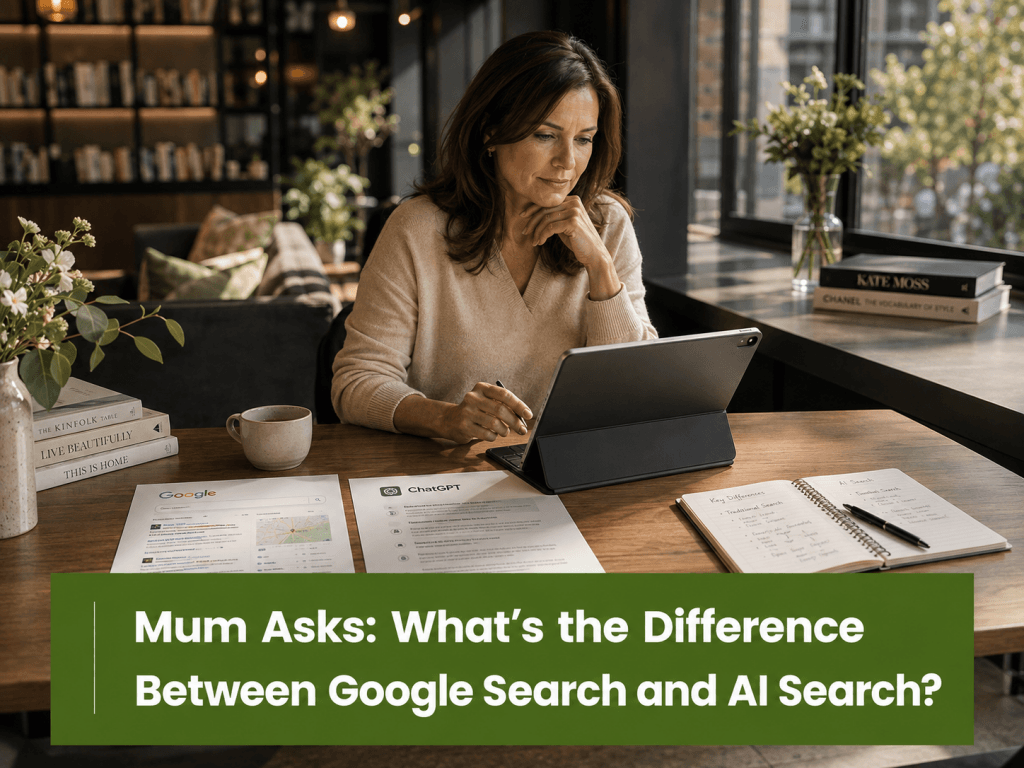
My mum asked me a simple question:
“If Google and ChatGPT both help me find things, what’s the difference between them?”
The simplest answer is:
Google usually helps you find information. AI Search more often tries to help you understand it and give you an answer.
Imagine you want to find a good Italian restaurant.
On Google, you might search:
Italian restaurant near me
Google will show you restaurants, maps, reviews, websites and articles. You then open a few options, read the reviews, look at the menus, compare prices and decide where to go.
With AI, you can approach the same task differently.
You might ask:
“I want to have dinner with a friend tonight at a quiet Italian restaurant near me. I’d like good pasta, moderate prices and easy parking. What would you recommend?”
AI can take those conditions into account. It may suggest several places and explain why each one could suit you.
So part of the work you would normally do yourself after searching can now be done by the system.
When Is Google More Useful, and When Is AI?
Google is useful when you want to look through the options yourself, open websites, check information or compare several sources.
AI is useful when you want an explanation, a recommendation or a quick way to understand a subject.
To get a more useful answer from AI, it helps to explain clearly what you actually need.
If you simply ask:
“What’s a good restaurant?”
the system has to guess what “good” means to you.
A better question includes some of the details that matter: where you are, how much you want to spend, what you prefer, what you want to avoid and who the answer is for.
For a trip, you could write:
“We’re going to Sydney for two days. We’re over 50, we don’t want to do too much walking, we like quiet areas and we want to stay close to public transport. Where should we stay?”
Now the AI has a much clearer picture of your situation and can shape the answer around it.
The First Answer Doesn’t Have to Be the Final One
With AI, you do not have to start a new search every time.
You can continue the conversation.
After receiving a few suggestions, you might ask:
“Which of these areas is quieter?”
Then perhaps:
“Which one is easier for getting into the city centre?”
Or you can narrow the choice:
“Show me only options under $250 a night.”
This way of searching is often called conversational search — searching through a conversation.
You get an answer, refine it and gradually guide the discussion towards what you need.
You can also tell AI who the answer is for.
You might say:
“Explain this to me as if I know nothing about investing.”
In another situation:
“Find options for an older person who finds it difficult to walk long distances.”
That extra information helps the system shape the answer for the person who will actually use it.
Can You Trust the Answer?
For a simple everyday question, an AI answer may sometimes be enough.
But if the decision is important, it is better to check the information.
Many AI systems show links or sources alongside their answers. You can open them and look at the original information yourself.
If you cannot see any sources, you can ask:
“Show me where I can check this information.”
Or:
“Find confirmation online and give me links to the sources.”
This is especially important when the question involves health, money, laws, travel, prices, timetables or anything else where getting the information wrong could have real consequences.
How to Use AI Search in Practice
The new part of searching with AI is that the quality of the answer can depend heavily on the information you give the system about your situation.
A short question may be enough for something simple. For a more complicated choice, give the AI the details that would matter if you were asking another person for advice.
You can then keep working with the answer instead of treating it as finished. Ask for a clearer explanation, narrow the options, change one of your conditions or explore another possibility.
That is perhaps the most useful habit to learn with AI Search: treat the search as a conversation that you can shape as you go.