


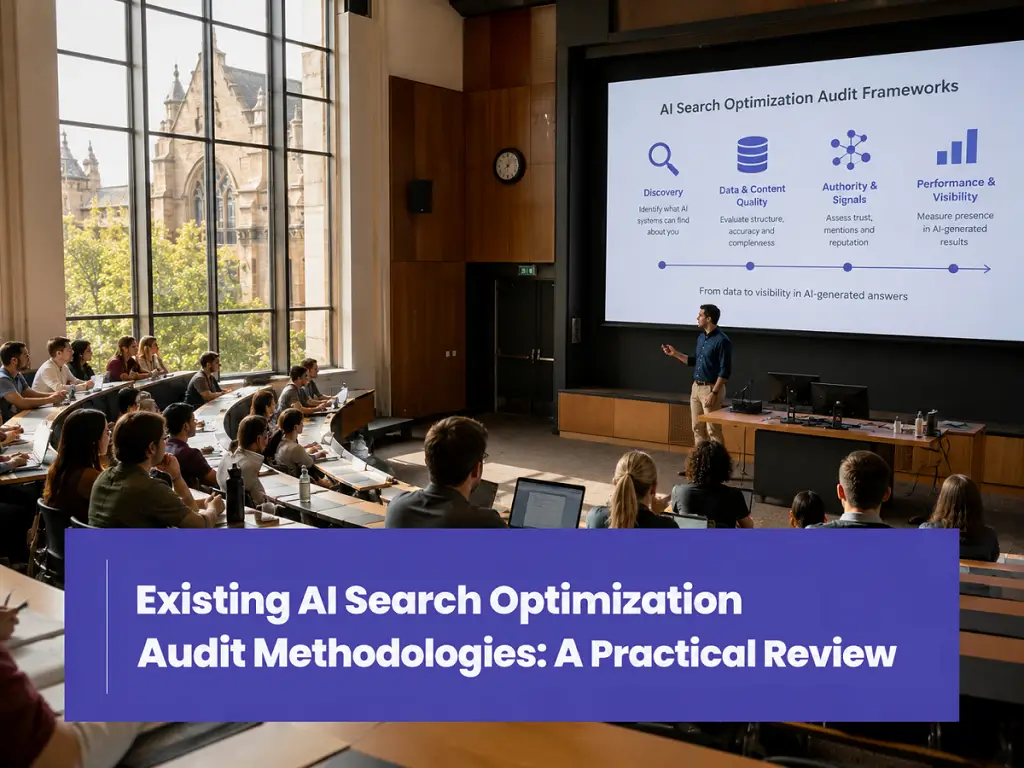
Over the past two years, AI-powered search platforms such as Google AI Overviews, ChatGPT, Microsoft Copilot, Gemini, Claude and Perplexity have begun changing the way people discover information online. As a result, a growing number of SEO agencies, consultants and software vendors now offer services under names such as AI Search Audit, AI Visibility Audit, GEO (Generative Engine Optimization) Audit, LLM Optimization Audit, and similar variations.
In this article, I use the term AI Search Optimization Audit because it better reflects the purpose of the process: not simply evaluating a website, but identifying opportunities to improve its visibility and performance in AI-powered search systems.
AI Search itself is evolving so rapidly that methodologies for evaluating and optimising websites are evolving alongside it. That’s hardly surprising. Each organisation naturally approaches AI Search from the perspective of its own expertise.
As I worked through these checklists and frameworks, one thing kept catching my attention. Although they often address similar challenges, each of them approaches AI Search from a slightly different perspective. Yet despite the rapid growth of the industry, there is still no universally accepted methodology for conducting a comprehensive AI Search Optimization Audit.
The purpose of this review is not to rank these methodologies or declare a winner. Instead, it is to understand how the industry is currently approaching AI Search Optimization Audits and what each approach contributes to the broader picture.
Despite these differences in terminology and emphasis, they all pursue essentially the same goal: evaluating how effectively a website can be discovered, understood, trusted and cited by AI-powered search systems.
Content-Focused AI Search Checklists
One well-known example is Aleyda Solis’ AI Search Optimization Checklist.
This approach focuses primarily on content rather than technical SEO. It encourages website owners to identify the search queries for which they want to appear in AI-generated answers, analyse which websites, publications and third-party sources AI-powered search systems currently rely on when responding to those queries, and improve their own content so that it is more likely to be referenced or cited in future AI-generated responses.
One of the biggest strengths of Aleyda’s approach is that it forces us to look at real user search intent. Instead of starting with our own content, we work backwards from the actual questions people ask AI search platforms. At the same time, this approach has an important limitation: if the technical foundations of a website are weak, even the best content checklist is unlikely to deliver strong results. It’s an excellent framework for content strategists and editors, but not a complete website audit methodology.
GEO (Generative Engine Optimization) Frameworks
Once we shift the focus from content to technical readiness, we arrive at GEO frameworks, such as the one developed by Onely.
Unlike purely content-oriented approaches, GEO frameworks evaluate whether a website is technically prepared to be effectively crawled, interpreted and used by modern AI-powered search systems.
Typical assessment areas include:
- Crawlability and technical accessibility (for example, whether a poorly configured script or Cloudflare challenge blocks OpenAI crawlers),
- Structured data (which entities your website exposes through Schema.org markup),
- Website architecture (how content is organised and how deeply important pages are buried),
- Entity recognition (whether AI systems correctly associate your brand with the relevant entities, rather than unrelated people, companies or concepts),
- Content extractability (how easily an LLM can extract relevant information without getting tripped up by messy layouts, heavy unoptimized popups, or infinite scroll).
Perhaps one of the most valuable aspects of GEO frameworks is that they remind us that even outstanding content may not perform well if the website itself is technically difficult for AI systems to crawl, understand or interpret.
However, most published GEO frameworks describe what should be evaluated rather than how each assessment should be performed. They provide valuable guidance but rarely define a repeatable audit methodology.
In practice, these frameworks often serve as an excellent planning tool before conducting a more detailed AI Search Optimization Audit.
AI Visibility Audits
Companies such as Ahrefs, Semrush and PageTraffic approach the problem from a different perspective.
Rather than concentrating primarily on technical SEO, these audits attempt to measure brand presence, citation frequency and visibility within AI-powered search platforms.
Typical questions include:
- Does ChatGPT mention the brand?
- Does Perplexity recommend the website for relevant searches?
- Does Google AI Overviews cite the website?
- Which competitors appear more frequently in AI-generated responses?
What makes these audits particularly valuable is that they measure the actual outcome of optimisation efforts rather than simply assessing technical implementation.
In practice, we often see an interesting paradox. A technically flawless website may receive little or no visibility in ChatGPT, while an old discussion forum with only average technical SEO is frequently cited by Perplexity simply because it has accumulated years of trust, authority and references across communities such as Reddit.
The limitation is that these audits often explain what is happening, but not necessarily why. They can reveal low AI visibility without providing sufficient technical diagnostics to identify the underlying causes.
For many businesses, this type of audit is especially valuable after optimisation work has already been completed.
Commercial AI Visibility Platforms
A growing number of commercial platforms, including solutions such as ZipTie, focus on continuous monitoring rather than one-time audits. This reflects a shift from one-off audits towards continuous measurement of AI visibility.
These platforms typically provide insights into:
- Brand mentions in AI-generated responses
- Citation frequency
- Competitor visibility
- Visibility trends over time
- Opportunities for improving AI Search performance
They are particularly valuable after optimisation work has been completed, allowing businesses to monitor how their visibility evolves over time.
However, most commercial platforms do not publicly disclose their complete audit methodology. While they provide useful dashboards, scores and recommendations, they rarely explain exactly which technical assessments are performed, how different factors are weighted or how the overall evaluation is calculated.
Technical SEO Frameworks That Continue to Shape AI Search Audits
Although tools such as Sitebulb and Screaming Frog SEO Spider are not positioned specifically as AI Search Optimization frameworks, they have had a significant influence on how modern technical audits are conducted.
Many AI Search methodologies continue to rely on the same technical foundations established by traditional Technical SEO, including:
- Crawlability
- Indexability
- HTTP status codes
- Redirect management
- Structured Data
- Internal linking
- Website architecture
Likewise, Google Search Central has not introduced a separate AI Search audit methodology. Instead, Google continues to emphasise that websites should follow established best practices for Technical SEO and high-quality content, considering these principles equally important for both traditional search and AI-powered search experiences.
At the same time, AI-powered search is changing how website success is evaluated. Technical SEO remains essential, but websites are increasingly evaluated through signals that extend beyond traditional search ranking factors, including entity recognition, brand authority, third-party references and visibility within AI-generated responses.
For that reason, AI Search Optimization should not be seen as a replacement for Technical SEO, but as its natural evolution. It builds upon the same technical foundations while expanding the signals that determine how websites are discovered, understood, trusted and cited by AI-powered search systems.
Conclusion
The field of AI Search Optimization Audits is still in its early stages.
Today, the industry offers a wide variety of checklists, frameworks and commercial platforms. Some focus on content optimisation, others assess technical readiness, while others measure AI visibility after optimisation has taken place.
Each approach addresses a different part of the overall challenge.
A more complete AI Search Optimization Audit should bring these perspectives together into a single, structured methodology. A complete audit shouldn’t focus solely on technical implementation or simply measure brand mentions. It should evaluate everything from crawlability, indexability and structured data to content quality, entity signals and actual AI visibility.
Trying to put these pieces together is what eventually led me to start developing my own methodology. My goal is to combine technical auditing, content evaluation and AI visibility measurement into a single, practical, repeatable and evidence-based process. In future articles, I’ll be sharing how this framework evolves, how it performs on real-world websites, and where the underlying assumptions hold up—or break down—when tested in practice. Stay tuned.
Further Reading
The following resources are worth exploring if you would like to learn more about the methodologies discussed in this review.
Google Search Central — AI Features & Search Guidance
Aleyda Solis — AI Search Optimization Checklist
Onely — GEO Checklist
Ahrefs — AI Visibility Audit
Semrush — AI Visibility Audit
PageTraffic — AI Visibility Audit Scorecard
ZipTie — AI Search Readiness
Sitebulb — Technical SEO Audit Checklist
Screaming Frog SEO Spider Documentation
This article is part of an ongoing research series documenting the development of a comprehensive AI Search Optimization methodology. A follow-up article looks more closely at the different perspectives these methodologies represent. Future articles will explore each of these areas in greater depth, share practical experiments and explain how the framework continues to evolve through real-world testing.


