When people talk about business visibility in AI Search, the conversation often moves quickly to technical questions: is the website indexed, can search engines access its pages, and are the main SEO elements configured correctly?
But a technically accessible website can still do a poor job of explaining what the business actually is. An AI system still has to work out who you are, what you do, which services you offer, and how different parts of the website relate to one another.
This is where website structure matters. A well-organised site helps connect individual facts into a coherent picture of the business and leaves less room for uncertain interpretation.
AI Can Access a Website and Still Misunderstand the Business
Technical accessibility answers one question: can the system retrieve the content of the website? Structure answers another: how easy is it to understand the business from that content?
Imagine a commercial cleaning company. The homepage says it provides cleaning solutions. Another page lists office cleaning, strata cleaning and end-of-lease cleaning. Melbourne appears in the footer, while the About page says the company works with businesses and property managers.
All the necessary facts are there, but the system still has to connect them into something like this:
Company → commercial cleaning provider → offers office and strata cleaning → serves businesses and property managers → operates in Melbourne
If a visitor has to open several disconnected pages just to understand what the company does, the problem is already visible at the level of ordinary user experience. For AI, the same fragmentation can make it harder to form a coherent representation of the business.
Make the Business Identity Explicit
One of the simplest ways to make a website easier to understand is to state clearly what the company is.
Many websites lead with marketing language:
Building better experiences.
Helping businesses move forward.
Solutions designed around you.
These phrases can work well as part of a brand, but they say very little about the business itself. A factual description nearby provides much more useful context.
For example:
OZZOU is a Melbourne digital agency specialising in business websites and AI Search Optimization.
Or:
ABC Accounting is a Melbourne accounting firm working with small businesses and independent professionals.
A sentence like this immediately establishes several important facts about the company.
The rest of the site does not need to read like a directory listing. Marketing language can stay, provided the core facts are stated clearly and remain consistent across the important pages.
Give Important Services Their Own Pages
If a service is a meaningful part of the business, a dedicated page usually gives it more context than a short mention on the homepage.
Imagine a digital agency offering Business Websites, Website Recovery, AI Search Optimization, AI Integration and Support & Maintenance. All of these services can appear on the homepage as an overview.
A dedicated service page can then explain what the service is, who it is for, what problems it solves and how it fits within the wider business.
The same principle applies in other industries. A dental clinic might have separate pages for general dentistry and implants. A construction company might separate renovations from new builds. An accounting firm might give tax returns and business advisory their own pages.
AI then sees more than a list of service names. It sees distinct areas of activity with their own context.
This does not mean every minor service needs a separate page. The important point is that the core areas of the business should be explained clearly rather than reduced to one line in a long list.
Build a Clear Hierarchy Between Pages
The next level is the position of each page within the website.
A clear architecture shows which pages are primary and which sit underneath broader services or topics.
For example:
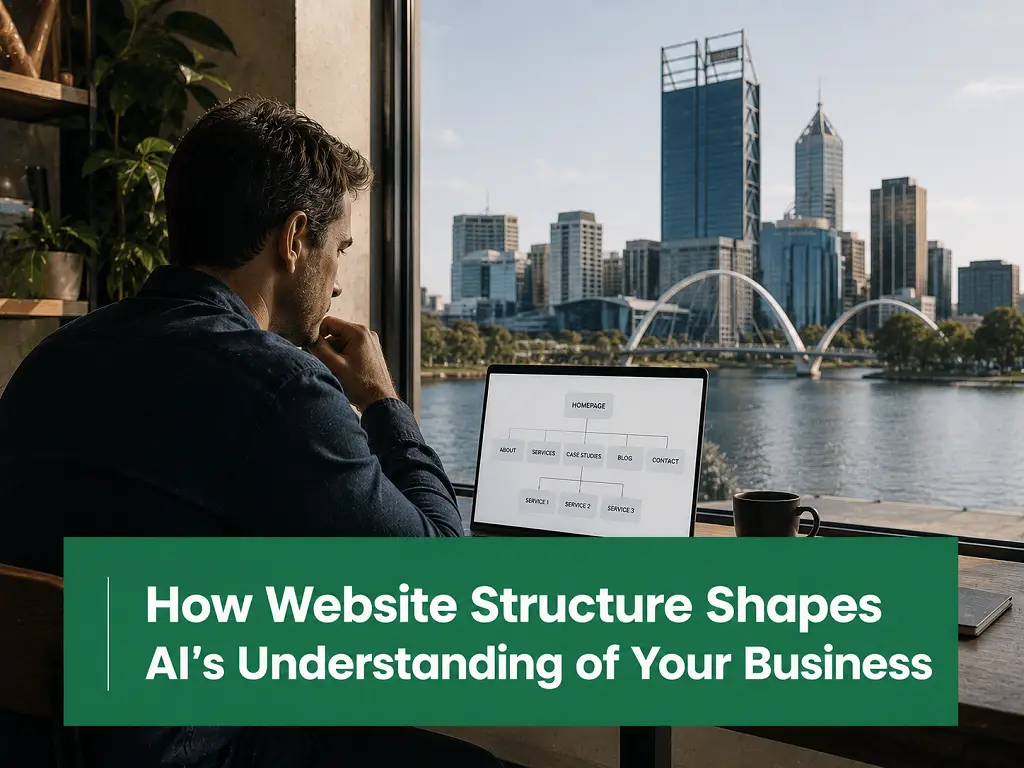
Home → Services → AI Search Optimization → AI Search Audit
The relationship is straightforward. AI Search Optimization is one of the company’s services, while AI Search Audit belongs within that broader area.
For another business, the structure might look like:
Home → Dental Services → Dental Implants
or:
Home → Commercial Cleaning → Office Cleaning
In each case, the more specific topic sits inside a broader context.
This hierarchy can be expressed through navigation, category pages, breadcrumbs or URL structure. The exact implementation will vary, but the architecture should reflect the real organisation of the business and its services.
If someone lands directly on an internal page, they should still be able to understand where that page sits within the website. For AI, that context helps prevent the page from being interpreted in isolation.
Show Relationships Within the Structure
Hierarchy explains where a page sits, but not every meaningful relationship fits neatly into a vertical structure. Internal links can show additional connections.
AI Search Optimization and Website Development, for example, may sit in different parts of a website, yet a particular article may connect them naturally. An AI Search Optimization page might link to an AI Search Audit, while a case study may link back to the service used in the project.
These links are useful when they reflect a genuine relationship. Their purpose is to show why one topic connects to another, rather than simply to connect as many pages as possible.
Headings play a similar role within a page. They separate different types of information and make it easier to distinguish the description of a service from details about who it is for or what the process includes.
FAQs, case studies and articles can add further context around the main pages when they are integrated into the wider structure rather than left as isolated content.
Keep the Core Facts Consistent
Even a well-organised website can create ambiguity if different pages describe the business in very different ways.
One page may call the company a digital agency, another a creative studio, and elsewhere it may be described as an AI consultancy. The same kind of variation can affect location: one page says Melbourne, while another says Australia-wide.
All of these descriptions may be valid. The problem begins when it becomes difficult to tell which description is central and how the others relate to it.
Consistency does not mean repeating exactly the same sentence on every page. It means keeping the core facts stable.
AI Search Optimization, for example, should be presented consistently if it is one of the company’s main services. A Melbourne-based company should not leave that connection to a single mention in the footer. The intended audience also needs to remain reasonably clear across the site so that different pages do not suggest incompatible customer groups.
The fewer contradictions there are in these basic facts, the easier it is to form a coherent picture of the company.
Good Structure Helps Understanding, Not Automatically Visibility
A well-structured website does not guarantee that a business will start appearing in answers from ChatGPT, Gemini, Copilot or other AI systems.
Its role is narrower: to help the system understand what the company is and how its main pages and services relate to one another.
Other factors still matter. The system has to discover the pages and access their content. Information about the company may need external confirmation, and the business still has to be relevant to the user’s specific request.
Website structure is therefore one of the foundational elements of AI Search Optimization, not a complete solution to the visibility problem.
Good structure reduces the risk that a system misunderstands what the company does or where a particular service fits within the business.
Make the Business Easy to Reconstruct
There is a simple way to look at the structure of your own website. Imagine that a person or an AI system sees several different pages from it.
Can they quickly understand what kind of company this is, what it does, which services are central and where the business operates? Do the different pages build the same overall picture?
If those answers are easy to find and do not contradict one another, the structure is doing its job.
The result is a website that is easier to navigate and a business that is easier for AI systems to interpret consistently.
The main principle is simple: structure the website so that the business does not have to be pieced together from scattered fragments.