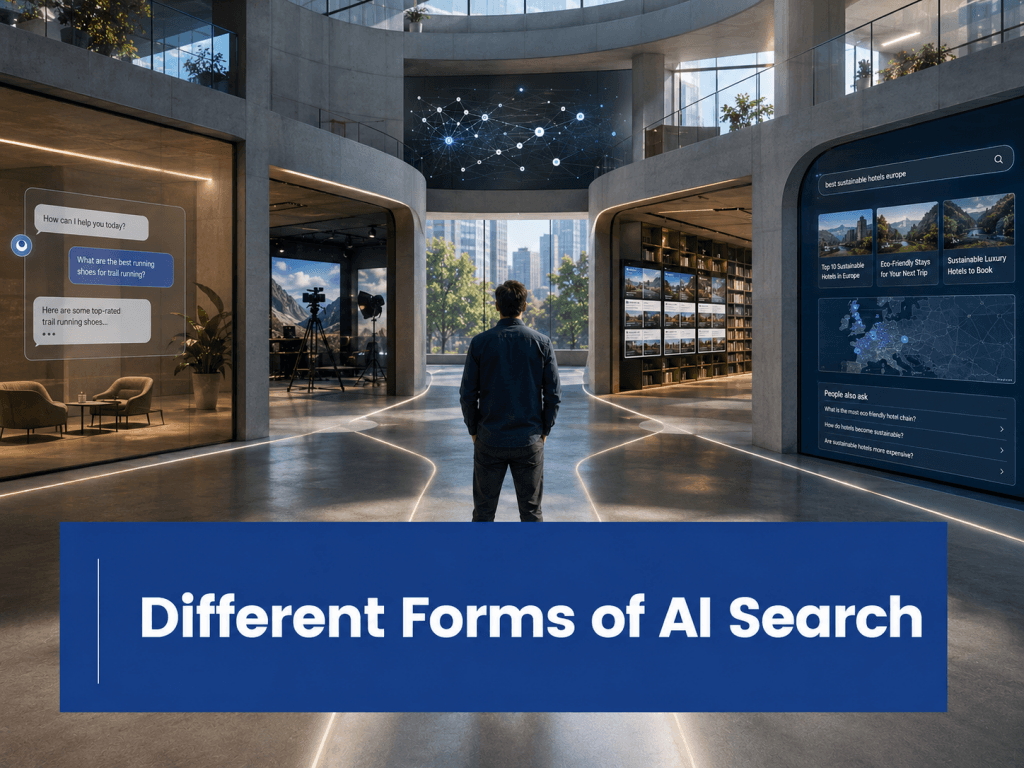
We increasingly use AI Search as a broad term for search experiences in which artificial intelligence helps interpret a task, retrieve information and shape the final result. Within that broad category, more specific terms are already in use: conversational search, agentic search, adaptive search, ambient search and multimodal search.
These terms cover different aspects of AI-mediated search: the way people interact with a system, how retrieval is conducted, the context available to the system and the degree of autonomy it can exercise. In practice, several of these characteristics can appear in the same product.
AI can also appear inside a traditional search interface without replacing it altogether. Google AI Overviews are a good example: the user still performs a conventional web search and sees familiar search results, but for some queries also receives an AI-generated summary with links to sources. This is an important form of AI-mediated search, best understood here as a way of integrating AI into an existing search experience rather than as another search model in its own right.
We have also deliberately left out two other common terms: answer engine and generative search. The first refers mainly to the form of the result — a direct answer rather than a list of links. The second concerns the use of generative models to produce that answer. Both operate at a different descriptive level from the approaches discussed below.
This taxonomy is also separate from terms such as AEO, GEO and LLMO, which concern approaches to improving content visibility in AI-driven search environments. Here, the focus is on the search experience and process itself.
Conversational Search — Search as a Dialogue
Conversational search is search that develops through a conversation.
In traditional search, a user formulates a query, receives results and, if necessary, performs another search. Even when those queries are related, much of the context may need to be repeated.
Conversational search allows the same information-seeking process to continue through a sequence of questions. The system retains the context of the exchange and understands what later follow-up questions refer to.
For example:
Which areas of Tokyo are best for tourists?
Which of those are quieter?
Which one is most convenient if I am flying into Haneda?
Find a few mid-range hotels there.
The user does not need to repeat that the discussion is about Tokyo, the areas already mentioned or the criteria established earlier. Each question builds on what came before.
The idea of conversational search predates the current generation of AI assistants, but large language models have made this form of interaction far more natural. A modern system can retain context across several turns and use later questions to refine what it retrieves and how it responds.
Agentic Search — Search That Can Conduct the Research Itself
Agentic search shifts part of the work of organising a search from the user to the system.
When given a complex task, the system may determine that a single query will not be enough. It can break the task into smaller parts and run additional searches, then examine what it finds and decide what still needs to be investigated.
For example:
Compare the electricity plans currently available for a two-person household in Melbourne and explain which option appears to make the most sense.
A useful answer may require checking several providers rather than relying on one search result. The system may need to examine usage rates and fixed charges, then look more closely at discounts or contract conditions before it can make a comparison.
The user defines the end goal, while the system works out which intermediate search actions are required.
This changes the role of search in a significant way. Instead of returning results from one query, the system can decide what it needs to investigate next, carry out those searches and use the findings to move towards the final answer.
Adaptive Search — Search That Changes Its Strategy
Adaptive search describes the ability of a search system to change its approach depending on the task and on what it has already found.
Not every question requires the same kind of search. One may need only a quick factual lookup. Another may require a broader investigation or additional verification before the system can answer with confidence.
If the first search produces enough information, the process may end there. When it does not, the system can try a different formulation or change the scope of the search. It may also decide that another source or another retrieval step is needed.
The important point is that the search strategy does not have to be fixed in advance. Its depth and direction can change while the task is being carried out.
That is the central idea behind the term adaptive: the search adjusts to the situation.
Ambient Search — Search Without an Explicit Query
Most familiar forms of search begin in the same way: a person decides to look for something.
They type a query, ask an assistant a question, give a voice command or show the system an image.
Ambient search suggests a different model. A system can interpret the surrounding context and retrieve potentially useful information even when the user has not explicitly initiated a search.
The idea predates the current wave of generative AI. Researchers were already experimenting with systems that could analyse an ongoing conversation, identify its subject and automatically surface related documents without a separate user query.
Today, the available context can be much broader. A system might have access to location, camera input or the activity currently taking place, as well as the conversation itself.
Imagine someone walking through an unfamiliar city while wearing AI-enabled glasses. The system can see the buildings around them, know their location and hear the conversation taking place. In principle, it may be able to determine what information would be useful before the user has formulated a direct question.
At its most extreme, ambient search becomes search without the act of searching.
Such a model naturally raises serious questions about privacy, permissions and control over the context a system is allowed to use. But the underlying idea is important because it changes the point at which search begins.
Multimodal Search — Search Beyond Text
For a long time, the primary form of a search query was text. Voice later became another important input. Modern AI systems can go much further.
Multimodal search allows different kinds of information to become part of the search task. An image, spoken question or video can provide information that once would have had to be translated into words before a search could begin.
Instead of trying to describe an unfamiliar plant, for example, a user can simply take a photograph and ask:
What is this?
Then:
Would it be suitable for a garden in Melbourne?
And after showing a second plant:
Which of these two handles hot summers better?
The image itself becomes part of the search task alongside the question and the context already established.
The same principle can apply to buildings, documents, charts, photographs, video or the surrounding environment captured by a camera.
Multimodal search therefore expands the idea of what a query can be. Much of the information a user once had to convert into keywords can now be supplied directly.
How These Approaches Overlap
The terms describe different dimensions of the same search experience.
Conversational search is primarily about interaction, while multimodal search expands the kinds of input that can become part of a query. Adaptive search concerns what happens inside the retrieval process when the system changes course. Agentic search adds a greater degree of autonomy, allowing the system to decide which search actions to take. Ambient search brings contextual signals into the process even when no explicit query has been made.
Consider an AI assistant built into smart glasses. A user might show it an object and ask a question by voice. They could continue the conversation without restating the earlier context. If the question required research, the system could run several searches of its own and change direction when the first results proved insufficient. Some information might even be surfaced because of what the system can see or infer from the immediate situation.
A single interaction can therefore move through several of these modes without the user ever needing to think about the terminology behind them.
AI Search as the Umbrella Term
AI Search remains useful precisely because the boundaries of a search interaction are becoming harder to define.
In traditional search, the user’s role was relatively clear: formulate a query, inspect the results and decide what to do next. AI systems are beginning to redistribute some of that work. They can carry context forward and recognise when more information is needed. From there, the system may decide how best to pursue it.
The broader change is therefore about the relationship between the user and the search system. Search is gradually moving from a tool that responds to individual queries towards a process in which the system can participate more actively in defining, pursuing and refining an information need.
Conversational, agentic, adaptive, ambient and multimodal search give us a vocabulary for describing different parts of that transition.
Further Reading
- Conversational Search: A Survey of Conversational Search — an academic overview of conversational retrieval, multi-turn interaction and the role of LLMs. A Survey of Conversational Search
- Agentic Search: OpenSearch documentation — a practical description of search in which an agent plans and executes retrieval. Agentic Search — OpenSearch
- Adaptive Search: AutoSearch: Adaptive Search Depth for Efficient Agentic RAG via Reinforcement Learning — research into adapting the depth of search to the task. AutoSearch: Adaptive Search Depth
- Ambient Search: Ambient Search: A Document Retrieval System for Speech Streams — a COLING 2016 paper on retrieval without an explicit user query. Ambient Search — ACL Anthology
- Multimodal Search: OpenSearch documentation — a technical example of retrieval across text and visual data. Multimodal Search — OpenSearch
- Generative AI inside traditional search: Google Search documentation on AI Overviews and AI Mode — useful background on how AI-generated responses can be integrated into existing web search. AI Features and Your Website — Google Search Central