Not long ago, advertising in AI Search was mostly a subject of prediction. In 2026, it has become a real market, although one that is still taking shape.
ChatGPT now shows ads to eligible Free and Go users and has been expanding the programme internationally. Google is testing sponsored formats inside AI Mode. Microsoft is developing advertising experiences for Copilot. Amazon is experimenting with scenarios where an ad can lead into a conversation and eventually a transaction.
Much of the underlying advertising infrastructure is familiar, from campaign buying and product data to conversion measurement.
So the interesting question is no longer whether advertising will appear in AI Search. It already has.
The more useful questions are where it appears, how it is separated from organic recommendations, what advertisers can already buy and measure, and where genuinely different mechanics are beginning to emerge.
1. What Counts as Advertising in AI Search?

An AI system can mention a company or product in its own answer. A separately labelled advertisement can appear alongside that answer. After recommending a product, the system may show a sponsored retailer. In another case, a commercial offer may appear later, once the user has compared several options and moved closer to a purchase.
All of these can happen within the same AI session, but they represent different forms of visibility.
If ChatGPT names a company in its answer, that does not by itself mean the company paid to be mentioned. If a Sponsored placement appears nearby, that is advertising.
An organic AI recommendation and a paid placement can appear side by side, but they get there through different mechanisms.
That distinction matters throughout the rest of the article. It affects disclosure, measurement, AI Search Optimization and the basic question of what an advertiser is actually able to buy.
2. Where Is Advertising Already Appearing?
There is no single standard format for AI advertising yet. Platforms are testing several different models.
Advertising After an AI Answer
The most familiar model is not fundamentally different from traditional search advertising.
In ChatGPT, an ad appears separately from the answer. The user can see the advertiser, the advertising message and the destination, with the placement clearly identified as Sponsored. OpenAI says advertising does not change ChatGPT’s answers.
Its relevance can reflect the subject and intent of an ongoing conversation rather than relying only on a short search query.
Sponsored Options After an Organic Choice
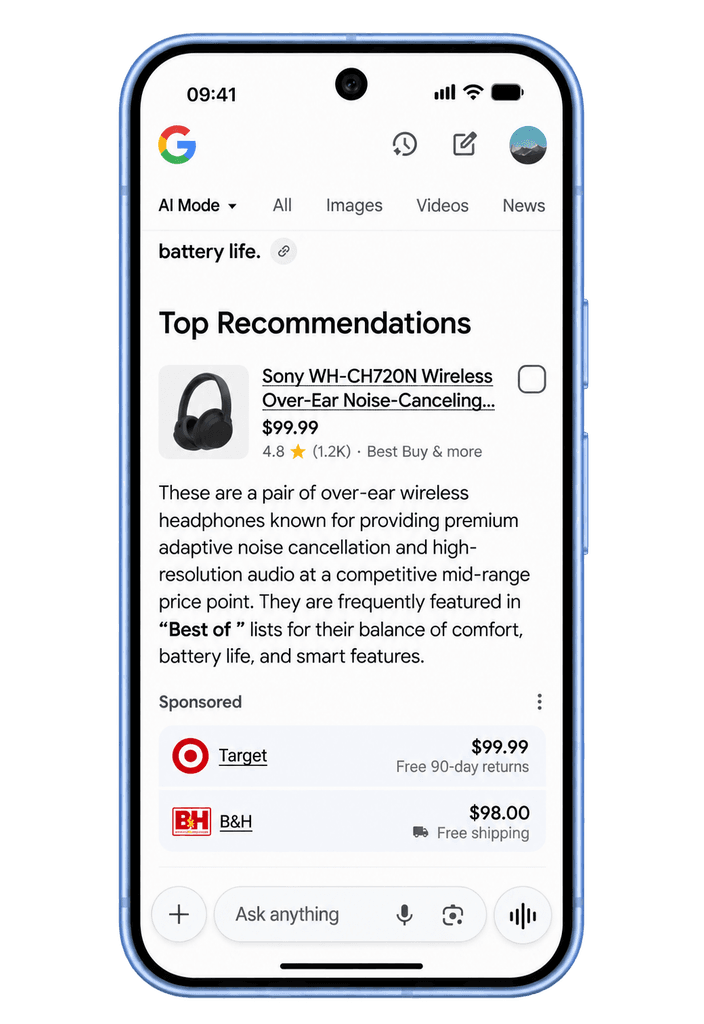
Google is testing another model in AI Mode.
The system may first surface products organically because they are relevant to the user’s request, then show sponsored retailers that sell those products. The commercial placements are separately labelled.
The division of roles is particularly easy to see here. AI can help narrow the choice first, while advertising enters at the next commercial step by providing a way to buy.
Google is also testing related approaches outside retail, including travel.
A Commercial Advantage at the Right Moment
Microsoft is experimenting with Offer Highlights in Copilot.
Advertisers can provide product differentiators through Microsoft Merchant Center, such as free shipping or in-store pickup. Copilot can then highlight a particular advantage when it is relevant to the user’s current decision.
What Copilot adds here is context-sensitive selection: it can surface the commercial attribute most relevant to the decision the user is making.

These examples already show how much variety sits under the label AI advertising: a separate ad unit, a sponsored buying option and a commercially relevant attribute surfaced within the context of a decision.
3. What Is Genuinely New in AI Advertising
The more significant change lies in the amount of context that can exist before an ad appears.
In traditional search, a query such as:
running shoes under $200
already carries useful commercial intent.
A conversation can gradually reveal considerably more:
I run about five kilometres four times a week
I don’t like an overly soft sole
I need shoes under $200
and ideally I want them delivered by Friday
By this point, the system has more than a product category and a budget. It also has several constraints, preferences and details about the intended purchase.
There is some evidence that ads are already appearing after this kind of conversational context has developed. Similarweb reported that 44% of ChatGPT ad impressions in its sample occurred on the first turn, while 56% appeared later in the conversation. It also found that 83% of prompts that triggered ChatGPT ads in its dataset would not have triggered a conventional Google Shopping ad.

Those figures come from one external data provider and should not be treated as a universal description of ChatGPT advertising. But they provide useful evidence for the underlying mechanism: an advertising opportunity can emerge after an initial question develops into a more specific need.
Another important development is the role AI can play in explaining a commercial offer.
Google is testing formats in which Gemini generates an additional explanation of why an advertised product or service may be relevant to the user’s question. That explanation appears alongside advertiser-provided creative, while the commercial experience remains labelled Sponsored.
At this point, the change goes beyond where an ad is placed. The AI system begins to participate in interpreting how a commercial offer relates to the user’s current task.
4. Where Does the Answer End and the Advertising Begin?
Disclosure is not a new problem. Search engines have labelled paid placements as Ads or Sponsored for years, and distinguishing advertising from organic results has always mattered.
AI Search adds another layer. Users also need to understand whether commercial interests can affect what the system itself says.
OpenAI draws a fairly explicit boundary here. The company says ads are separate from ChatGPT’s answers and do not influence their content. Advertisers also do not receive access to individual user conversations.
Google continues to use Sponsored labelling in newer formats, including those where Gemini generates an explanation around the advertiser’s offer.
This makes the origin of a message particularly important. A user should be able to understand which part was produced as the system’s answer and which part exists because an advertiser paid for commercial visibility.
There is also a subtler question about perception.
In AI Search, advertising may appear after a conversation in which someone has described their situation in detail and asked the system for help making a decision. We do not yet know whether trust in an AI assistant will affect how users perceive advertising placed alongside that interaction.
There is no basis yet for assuming that people will automatically trust such advertising more, or confuse it with an organic recommendation more often. But the boundary between the system’s advice and a paid commercial message is becoming an important area to watch.
5. Can You Pay for an AI Recommendation?
Today, not if by recommendation we mean the organic answer produced by the system itself.
An advertiser can buy commercial placement on AI surfaces that a platform has opened to advertising. That may be an ad beside a conversation, a sponsored retailer or another clearly identified commercial offer.
The organic selection process remains separate.
For a business, this creates two different areas of work. Organic visibility depends on how easily AI systems can discover the business, understand it and consider it relevant to a particular need. That broader process is explored in more detail in What Does AI Search Optimization Actually Optimize?.
Paid visibility is purchased through the platform’s advertising products.
The two can operate at the same time, but one does not substitute for the other.
6. Shopping Has Become the Main Testing Ground
A large share of current experimentation is happening around shopping.
Google is developing sponsored retailers, Direct Offers, conversational product formats and new Merchant Center attributes for AI-assisted shopping. Microsoft introduced Offer Highlights for retail use cases. Amazon is bringing conversational advertising into Alexa for Shopping. ChatGPT Ads also supports product-focused campaigns.
Shopping already has a large supply of structured commercial information: price, availability, delivery options, size, colour, compatibility, warranty terms and returns policies. These attributes are relatively easy for a system to compare and use when filtering options.
That makes shopping particularly suitable for AI-assisted decision-making. A system can clarify requirements, narrow the available products and then connect the remaining choices with current commercial offers.
Advertisers also have relatively clear outcomes to measure. Retail journeys commonly produce observable actions such as product views, clicks, add-to-cart events, checkout and purchase.
The combination of structured data, clear commercial intent and measurable outcomes makes shopping a natural environment for early experimentation.
That still does not prove that shopping will become the first fully mature category of AI advertising. It does suggest that stable models may emerge there relatively early because much of the required data and commercial infrastructure already exists.
7. What Advertisers Can Already Buy
From the advertiser’s side, AI advertising currently looks much more familiar than it does from the user’s side.
ChatGPT Ads supports established buying models and provides a self-service Ads Manager for creating and managing campaigns. OpenAI has also been expanding conversion measurement and advertiser tooling.
Google is extending much of its existing advertising infrastructure into AI Mode and other AI-powered Search experiences.
Microsoft is following a similar path. Existing search campaigns can reach newer Copilot surfaces, while formats such as Offer Highlights are being developed specifically for conversational decision-making.
Advertisers therefore continue to work with familiar components: campaign settings, bids, creative assets, product data, budgets and conversions.
What changes is the point at which advertising meets the user and the context surrounding that moment.

8. What Can Already Be Measured
The basic performance metrics are familiar too.
ChatGPT Ads provides metrics such as impressions, clicks, spend, CTR, CPC, CPM and conversions. Advertisers receive aggregated performance data rather than the contents of individual conversations.
At campaign level, this is already enough to measure the cost of a placement and observe direct actions after an advertising interaction.
Attribution becomes harder when that interaction sits inside a longer AI-assisted journey.
A user may begin by researching a category, refine their requirements over several turns, compare options and encounter an advertisement only later. Recording the click itself is straightforward. Separating its contribution from everything the AI interaction did before the click is much harder.
Similarweb has also pointed to a wider measurement gap. Advertisers can see their own campaign performance but have a much weaker view of the conversations around those ads, competitive share of voice and the broader context in which an impression occurred.
Google can present a similar problem where performance from AI-powered formats is incorporated into broader campaign reporting.
The advertising event itself is already measurable with largely familiar tools. Understanding its role within the full AI-assisted decision process is much less developed.
9. The Market Is Still Experimental
Despite real launches and growing advertiser participation, platforms are still testing different ideas about what advertising should do inside an AI experience.
ChatGPT largely preserves a distinct ad unit alongside the conversation. Google is experimenting with sponsored buying options and AI-generated explanations. Microsoft is exploring context-sensitive offer attributes. Amazon is testing experiences where the commercial interaction can continue through conversation.
The acceptable use of conversational context has not settled either. More context can improve relevance, but it also increases the importance of privacy, disclosure and user control.
Reporting remains incomplete as well. Advertisers can measure many visible outcomes without necessarily understanding the full interaction that led to them.
For now, AI advertising is best understood as several models being tested in parallel. Platforms are still working out where advertising belongs within an AI interaction, how much personal or conversational context should be used and how active a role the AI itself should play around a commercial message.
10. When AI Starts Taking Action
The next stage goes beyond simply showing an advertisement.
Google is building infrastructure for agentic commerce, including the Universal Commerce Protocol and additional product attributes designed to help AI systems work with commercial information during discovery, comparison and transaction-related tasks.
Amazon provides an even more direct example. Alexa+ Agentic Ads can begin with an advertising offer, continue into a conversation, answer follow-up questions and, in some cases, lead to a completed transaction. Early demonstrations have included ordering food and buying concert tickets.
We are still a long way from a world in which autonomous AI buyers routinely make purchases without human involvement. But the direction is visible: AI can perform an increasing amount of the work between initial interest and a transaction.
Imagine asking:
Find me a lightweight laptop under $2,000 for work and travel. Compare the best options.
The system could examine specifications, check prices and availability, compare delivery conditions and narrow the field to a few suitable models.
In that environment, advertisers still need to communicate with the person making the purchase. At the same time, commercial information needs to be clear and structured enough for the AI system participating in the comparison.
A person may respond to the brand, imagery, design or an emotional proposition. For an AI system, the useful part is reliable commercial data it can compare and act on.
That includes whether a product is available, whether it fits the user’s constraints and what happens after the purchase.
This is not yet a distinct advertising market aimed at AI agents. What we are seeing are the first situations in which AI becomes an active intermediary between a commercial offer and the buyer.

Conclusion
AI advertising does not yet look like a separate, fully formed advertising system.
Existing advertising infrastructure is gradually adapting to an environment where discovery increasingly happens through conversation, AI helps people compare options, and a commercial offer may appear only after the user’s needs have been refined over several steps.
The larger change will come from the role AI takes on between a user’s question and eventual action. The more of that journey the system can interpret, compare or execute, the more advertising will have to adapt around it.
That is where the market is beginning to move beyond simply placing ads inside an AI interface.
Advertising Platforms and Resources
For practitioners who want to explore the platforms and formats directly:
Alexa+ Agentic Ads — Amazon’s official resource on conversational and agentic advertising formats in Alexa+.
https://advertising.amazon.com/library/news/alexa-agentic-ads
OpenAI Ads Manager — create and manage advertising campaigns in ChatGPT.
https://ads.openai.com/
Google Ads — advertising across Google Search and Shopping, including emerging advertising formats in AI-powered search experiences.
https://ads.google.com/
Microsoft Advertising — advertising across Microsoft Search and Copilot experiences, including Offer Highlights.
https://ads.microsoft.com/