There are several reasons why someone might want to understand the skill set behind AI Search.
If you already work in SEO, content, web development, analytics, PR or digital strategy and want to move into AI Search, you need to know which of your existing skills transfer — and what you still need to learn.
If you run an agency or digital team, you need to understand which competencies an AI Search practice requires. And if you are hiring an AI Search specialist, GEO specialist or someone for a broader search role with AI responsibilities, it helps to know which requirements genuinely recur across the market and how this skill set differs from traditional SEO.
To look at the question through the market rather than construct an ideal competency list ourselves, we reviewed dozens of AI Search-related job listings from more than 60 employers across multiple job platforms and company career sites. These included dedicated AI Search, GEO and AEO positions, as well as broader SEO and search roles where AI Search represents a meaningful part of the job.
This article looks specifically at skills and areas of knowledge. We are not examining how an AI Search agency or team might be structured, or how these competencies might be divided between individual positions. We cover that separately in [[our article on AI Search agency roles and structure]].
Job listings provide useful evidence of the skills and experience employers are currently looking for, but they do not necessarily provide a complete definition of the profession. Where relevant, we therefore distinguish between what employers are asking for and where our own professional assessment goes somewhat further.
1. Search and Technical Web Knowledge Remain the Foundation
The most consistent pattern across the roles we reviewed was the strong connection between AI Search and an established search background.
Employers regularly ask for SEO and technical SEO experience. Recurring requirements include crawling and indexing, site architecture, internal linking, on-page optimisation, canonicalisation, structured data, HTML, CMS knowledge and an understanding of how website information becomes technically accessible to search and AI systems.
These requirements do not appear only in conventional SEO jobs with a few AI responsibilities added. They also occur in dedicated GEO, AEO and AI Search positions.
The conclusion is fairly straightforward: traditional search and web skills remain a foundation of AI Search work.
For an SEO or technical SEO specialist, this means a substantial part of their existing professional foundation transfers directly. For an employer, search experience remains an important indicator of whether a candidate can investigate AI visibility problems at website level.
2. Content Skills Increasingly Include Semantics, Entities and Information Structure
Content also appears consistently in employer requirements, but the skill set usually extends beyond writing or conventional on-page optimisation.
Job listings refer to semantic optimisation, entity-based content, topical authority, answer-focused content, information architecture, structured content and Schema.org.
In effect, the market increasingly expects specialists to work not only with text, but with how clearly and consistently the underlying information is represented — companies, products, services, entities and the relationships between them.
Content skills in AI Search therefore naturally overlap with semantics, entity thinking and information architecture.
Structured data also appears regularly within this group of requirements. Its importance should not be overstated: schema is not a mechanism for directly transmitting knowledge to ChatGPT, nor does it guarantee inclusion in an AI-generated answer. But an understanding of structured information understandably forms part of the skill set employers are looking for.
For people coming from content, editorial or information architecture backgrounds, much of this competence is already familiar. AI Search gives it an additional application: the work concerns not only the quality of individual pieces of content, but also how clearly information is represented as a system.
3. What AI Search Adds to the Traditional SEO Skill Set
This is where the competencies that distinguish AI Search from a typical SEO position become most visible.
Many specialist roles ask for a practical understanding of LLM-based systems: retrieval, source selection, citations, synthesis and generation. A specialist does not need to build a language model, but needs enough understanding to investigate how an AI system finds, selects and uses information.
A second group of requirements concerns AI Search research and investigation.
Employers mention prompt sets, query libraries, competitor analysis, systematic testing, citation analysis and investigation of how companies or products are represented in generated answers. This kind of work also involves direct testing across major AI assistants and search systems such as ChatGPT, Claude, Gemini and Perplexity.
AI-assisted workflows, agents and automation for research, monitoring, analysis and reporting are also appearing in job descriptions.
Prompting as a standalone skill is less consistently requested than SEO, content or analytics. This is one area where our assessment goes somewhat further than the literal frequency of the requirement in job listings.
We consider prompting and query design an important practical AI Search skill, because a substantial amount of AI Search research is conducted through queries: exploring different intents, conducting follow-up investigations, comparing competitors, creating repeatable tests and examining how wording affects results.
There is another AI-specific competence as well: the ability to work with variable generated outputs without drawing overly strong conclusions from a single response.
Together, these requirements show most clearly what AI Search adds to the traditional search skill set: its own research layer built around AI systems.
4. Measurement and Experimentation Are Becoming a Distinct Professional Competence
Another highly consistent market pattern is the emphasis on measurement.
Employers want to track AI visibility, citations, mentions, share of voice, presence across query or prompt sets, and changes in these indicators over time. Listings also mention baselines, experimentation, repeatable testing frameworks and reporting.
In more developed roles, measurement is already being connected not only to visibility but also to business outcomes, including AI referral traffic, assisted conversions, pipeline and revenue contribution.
A specialist needs to understand what a metric actually measures and how the underlying test was designed. Results also need to be judged for reproducibility and for the strength of the conclusions they can reasonably support.
In our view, this is one of the core competencies of the profession.
For someone coming from analytics or experimentation, there are substantial transferable skills here. The objects being measured and some of the tools may change, but the discipline of working with evidence remains familiar.
5. AI Search Requires an Understanding of the Wider Information Environment
The job listings we reviewed regularly mention digital PR, earned media, backlinks, authoritative mentions, third-party publications, reviews, directories and online communities.
Those requirements extend the work well beyond the organisation’s own website.
In practice, information about a business may exist across Google Business Profile and Google Maps, social media, review platforms, business directories, industry websites, news and media coverage, Reddit and other forums, YouTube, professional communities and third-party publications.
An AI Search specialist needs to understand how consistently the organisation is represented across these sources, where it is mentioned, which sources carry authority and where contradictory information may exist.
This is where AI Search naturally intersects with digital PR, reputation and authority building.
For specialists coming from PR, link building or brand reputation, this is another area where existing experience can transfer directly into AI Search.
6. Strategy, Business Judgement and Communication
The market also makes it clear that AI Search is not simply a collection of technical tasks.
Job requirements regularly include business objectives, prioritisation, competitive analysis, stakeholder management, reporting and the ability to turn analytical findings into clear recommendations.
AI visibility by itself is not a sufficient business objective. A specialist needs to understand which products, services, audiences and queries actually matter, and which actions deserve priority.
That also makes professional judgement important.
In AI Search, it is not always possible to establish precisely what mechanism produced a particular result. A specialist therefore needs to judge the strength of the available evidence and be clear when a conclusion remains a hypothesis rather than an established finding.
For an agency owner or hiring manager, this matters particularly: professional competence is not defined by technical knowledge alone, but also by the ability to make sound decisions and explain them to clients, teams or management.
7. Tools and Platforms Are Part of the Working Skill Set
Professional tools feature prominently in the job listings we reviewed.
Listings regularly mention Google Search Console, Google Analytics, Semrush, Ahrefs, Screaming Frog, Looker Studio, Conductor, BrightEdge and other established search and analytics platforms.
Specialist AI visibility and monitoring platforms are increasingly appearing alongside these established tools, while some positions also mention automation tools, APIs and AI agents.
There is an important distinction here.
Some tools have long been standard parts of search and analytics work. Experience with Google Search Console, analytics platforms, crawlers or established SEO suites is a conventional professional requirement.
A different situation arises when a vacancy specifically requires experience with a particular new or specialised AI Search platform.
In those cases, experience with the underlying type of work is often more useful than familiarity with one particular product: AI visibility tracking, citation monitoring, prompt-set analysis, competitor comparison, reporting or another form of analysis.
Someone who can already perform that work professionally using one system will generally be learning a new working tool when moving to another platform, rather than acquiring an entirely new professional discipline.
So when a job description names a particular platform, it is useful to look beyond the product itself and ask what professional capability the employer is actually trying to assess.
8. When Job Listings Ask for Too Much
Some of the listings we reviewed contained skills that appeared unusual for AI Search positions: Python, SQL, data pipelines, ETL/ELT, RAG, advanced scripting and more specialised engineering skills.
Notably, these requirements appeared more often in in-house listings. This is a familiar problem in other areas of IT as well: companies recruiting an internal specialist sometimes fill a job description with almost everything they can imagine might have some connection to the role.
There are cases where these requirements are entirely justified by the position.
In one listing, for example, Python, SQL and data pipelines were required because the role effectively sat at the intersection of GEO and data engineering. That is not a typical AI Search optimisation position; it is a considerably more engineering-focused role.
In another case, SQL was required because the specialist would work with a large proprietary dataset at an AI visibility start-up. The requirement made sense for that company, but reflected the architecture of its product rather than the standard skill set of an AI Search specialist.
Across our sample, Python, SQL, data engineering, RAG and similar capabilities do not appear to be characteristic requirements of the profession as a whole.
This is also why specialist AI Search, SEO and digital agency listings tend to provide a much cleaner picture. Their requirements are more consistently concentrated around the competencies that recurred throughout our research: search and technical web knowledge, content and semantics, AI systems, research and prompting, measurement, external authority, strategy and professional tools.
For candidates, there is a practical lesson here. If a listing contains an unusually broad collection of requirements, do not automatically assume that every one represents a standard skill of the profession. Ask the employer what the skill will actually be used for and how central it is to the day-to-day role.
Employers should keep the other side of the same problem in mind: a job description becomes less useful when it turns into a list of everything that could conceivably be helpful. Clearly separating core requirements from company-specific or optional skills makes the role easier to understand and helps attract a more relevant group of candidates.
9. Where Can These Skills Be Learned?
There is already a substantial amount of training available across most of the areas that make up AI Search work.
There are dedicated courses in technical SEO, structured data, content and entity optimisation, LLMs, prompting, analytics and experimentation. Specialist training in GEO, AEO and AI Search itself is also increasingly available.
We reviewed many of these options separately in Where Can You Study AI Search?.
Any such course list should be treated as a snapshot of the market at the time it was published. Programmes change, new providers appear, course content evolves and new tools emerge. If you are choosing training, it is worth doing current research even when starting from an existing list.
What the Market Ultimately Shows
The job listings point to a profession drawing on several established disciplines while adding a distinct set of AI-specific capabilities.
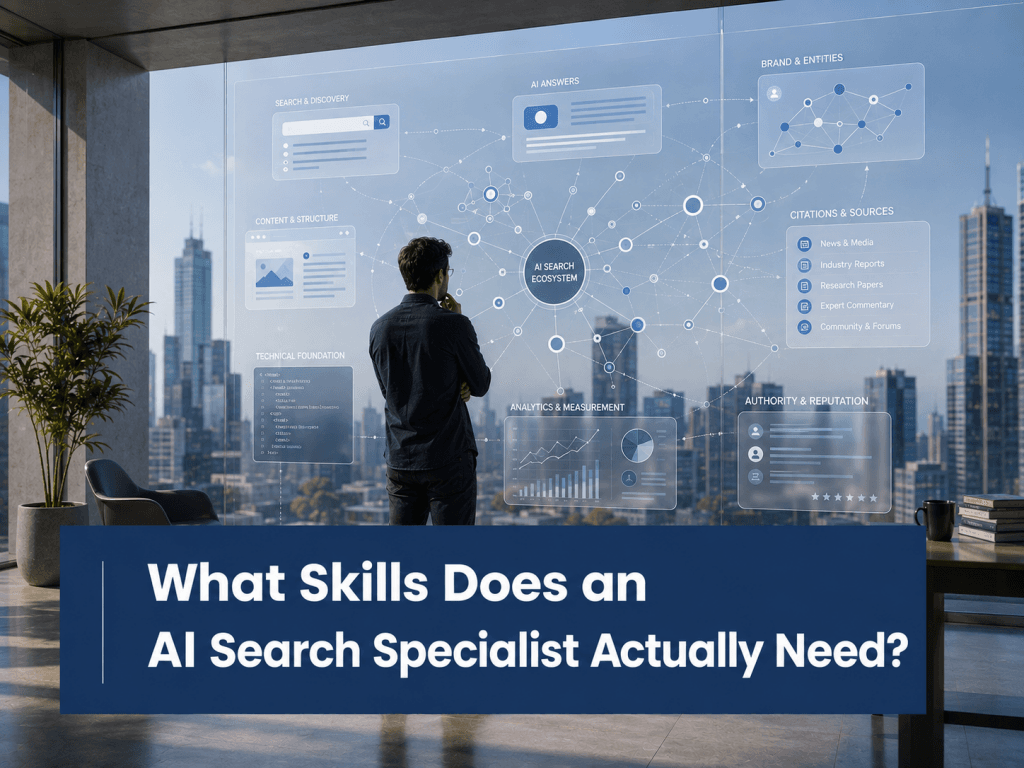
AI Search is best described today as a hybrid profession at the intersection of search, web technology, information, AI systems, measurement, authority and strategy — with its own tasks and methods of working.
The exact balance varies considerably between roles. An agency specialist, an in-house hire and someone working for an AI Search platform may need different levels of technical, analytical or strategic depth. That is why individual job descriptions need to be read in context — and why recurring requirements across many employers tell us more about the profession than the longest skills list in any single vacancy.