If you’ve asked yourself these questions, so have I.
If nobody can guarantee that ChatGPT, Gemini, Copilot or another AI system will recommend my business, what exactly am I paying for?
If my website can be found but not used, cited without a link, or my business mentioned without being recommended, what practical value am I really getting?
How do I know whether AI Search Optimization is actually changing anything?
And what happens if I do everything properly and an AI system still recommends a competitor?
These are reasonable questions. I know because I have asked them myself.
The more I worked with AI Search, the more often I came back to the same issue: if so much of the final outcome sits outside our direct control, what should a business realistically expect from optimization?
The answer starts with being very clear about what the work can actually change.
What Is the Business Actually Paying For?
Imagine an agency telling you that it will improve your website structure, technical accessibility, service pages, structured data, consistency of business information and wider digital presence.
Then it adds:
“We still can’t guarantee that ChatGPT will recommend you.”
The obvious response is: then what exactly have I paid for?
That question deserves a proper answer. Without one, AI Search Optimization can easily sound like a service built around uncertainty: work is done, money is spent, but the final outcome still depends on a system nobody controls.
The problem usually begins when the expected result is reduced to one event: an AI system must produce a particular recommendation.
Why Nobody Can Promise a Specific AI Answer
An agency does not control the AI model itself. It does not know what a future customer will ask, what context will already exist in that conversation, which sources the system will retrieve, how those sources will be used or how the final response will be phrased.
So no serious provider can sell you a guaranteed future ChatGPT answer.
What a business can influence are many of the conditions that shape that answer. Important information can be made easier to access, services and specialisation can be explained more clearly, and contradictions across different sources can be removed. The wider digital presence can also give AI systems a clearer picture of who the business serves, what problems it solves and where it operates, while stronger external evidence can support those claims.
That changes how the problem should be approached.
The task is no longer to “make ChatGPT say this”. The task is to improve the information environment from which AI systems form their understanding of the business.
What Actually Changes After Optimization
Consider two companies offering the same service in the same city.
The first has a poorly structured website. Its services are described vaguely. Business information differs across sources. It is difficult to tell exactly who the company serves or what it specialises in. Important customer questions are not answered clearly, and there is little external evidence supporting its positioning.
The second company has worked through those issues. Its services are clearly described. Its information is consistent. Its pages explain when and for whom the business is relevant, and important claims are supported elsewhere.
We still cannot know in advance which company an AI system will recommend in one particular conversation.
But the two businesses are no longer in the same position.
In the second case, the system has a much clearer basis for understanding what the company does, who it serves, where it operates and when it may be relevant to a user’s request. There is more usable, consistent and supporting information available to connect that business with the right need.
That is where optimization creates value. It makes the business easier to understand and gives AI systems a stronger basis for considering it when the context is relevant.
This is also why the fact that AI can find a business and still not recommend it does not make the earlier work pointless. Discovery is only one part of the process. Being understood, matched to the request and supported by enough evidence all contribute to what happens next.
Different Improvements Can Work Together
AI Search Optimization rarely depends on one change.
A typical programme may improve several areas at once:
- whether important information can be discovered;
- how clearly services and specialisation are explained;
- how well pages answer the questions potential customers actually ask;
- how consistent business information is across different sources;
- how well important claims are supported externally;
- how technically accessible and structured that information is.
These improvements interact. Better technical access matters more when the information itself is clear and relevant, while clear positioning becomes more credible when the same picture is supported consistently across the wider web. The result is a set of improvements reinforcing one another rather than six unrelated pieces of work.
This is where a simple mathematical example is useful.
Imagine five different measures, each improving by 25%. Their combined multiplier would be:
1.25⁵ ≈ 3.05
In other words, the combined figure would be roughly 305% of the original level.
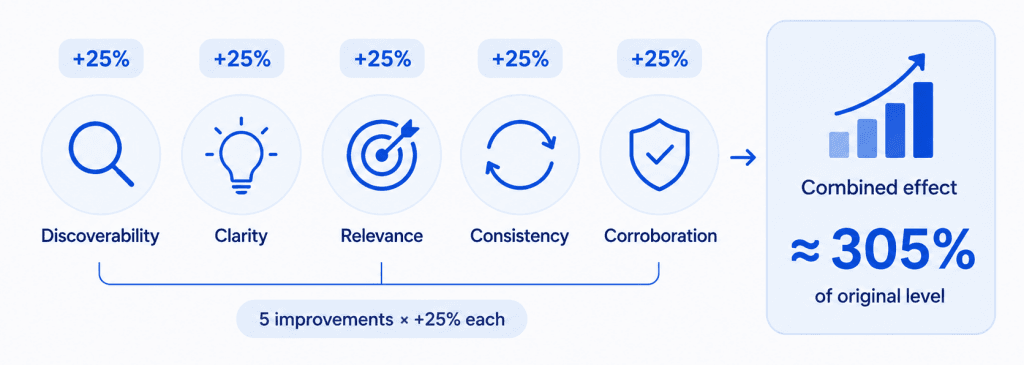
This is, of course, not a formula for the effectiveness of AI Search Optimization, nor a promise that the probability of recommendation will increase by anything like that amount.
It is simply a mathematical illustration of a broader principle: when several improvements work together and compound, their combined effect can be much stronger than the effect of each change on its own.
That is why AI Search Optimization makes more sense as a system of improvements than as a hunt for one setting that supposedly makes AI recommend a company.
I explored those different optimization targets in more detail in What Does AI Search Optimization Actually Optimize?.
Different Outcomes Have Different Business Value
Another source of confusion is the way AI visibility is often discussed as if it were one linear sequence.
Possible outcomes include:
- a page being found;
- information being used;
- a source being cited;
- a business being named;
- a company being recommended;
- a link being shown.
It is tempting to see these as stages on one ladder, with full value arriving only when every stage has been completed.
For a business, that is often the wrong way to look at it.
Imagine someone asking an AI system which companies in Melbourne are suitable for a particular service. The system names your company, explains correctly what it does and gives the user a reason to consider it, but does not show a link to your website.
A link would clearly be useful. It could bring direct traffic.
But the absence of a link does not remove the commercial value of the recommendation. The potential customer has already encountered the company name and been given a reason to consider it.
Now take the opposite case. An AI system cites an article from your website in an informational answer, but when the user later asks which company they should hire, your business does not appear at all.
Those two outcomes are not commercially equivalent.
A business recommendation without a website link may be far more valuable than a website citation without a business recommendation.
That is why it helps to separate two ideas.
Source visibility is about whether your pages and content are found, used and cited.
Business visibility is about whether the company itself appears in descriptions, comparisons and recommendations.
Both matter, although for many businesses the more important commercial question is whether the company enters the set of options an AI system presents to a potential customer.
Once you look at it this way, success becomes broader than “did we get the citation?” or “did we get the link?”
How This Compares With Other Business Investments
Businesses make decisions under uncertainty all the time.
SEO does not guarantee the first position for every search. Advertising does not guarantee a sale. A new website does not guarantee revenue growth. Hiring a salesperson does not guarantee a fixed number of contracts.
Yet businesses still invest in all of them, because a useful investment does not have to control the final outcome completely.
What matters is whether the mechanism makes sense, whether the work improves conditions connected to the desired result, whether the effect can be observed and whether the potential return justifies the cost.
AI Search Optimization should be evaluated in exactly that way.
The absence of a guaranteed recommendation does not make the work irrational. It simply means that the business should judge the investment by changes it can influence and measure rather than by a promise nobody can honestly make.
Much of the Work Remains an Asset of the Business
There is another reason I do not see AI Search Optimization as a bet on a black box.
A large part of the work improves the business’s own digital assets regardless of what any one AI platform does.
A clearer website structure helps visitors. Better service descriptions make the offer easier to understand. Technical accessibility matters to traditional search engines as well as AI systems. Consistent information reduces confusion across different digital channels. Strong content can support organic visibility, sales conversations and other marketing activity.
The business is therefore improving its website, its information, its positioning and the way its expertise is represented across the web. Those improvements remain useful even if a particular AI platform changes how it retrieves, cites or recommends information tomorrow.
What Should an Agency Be Responsible For?
Once a specific recommendation cannot be guaranteed, the agency’s responsibilities need to be defined clearly.
The client should know what will be done and how progress will be judged.
A sensible process should include:
- establishing a baseline;
- checking how the business currently appears across relevant AI systems and queries;
- identifying problems the business can realistically influence;
- fixing technical, structural and information weaknesses;
- improving how services, expertise and positioning are represented;
- checking whether important information is consistent and supported;
- repeating the same measurements after the changes.
A professional engagement should leave the client with a clear starting point, a record of the problems identified, a record of the changes made and a way to run the same checks again and see what moved.
That is why measurement matters so much here. One favourable or unfavourable AI answer tells us very little. Patterns across repeated prompts, systems and time are far more useful. I describe that process in more detail in Measuring AI Visibility.
This is the part that turns optimization from a vague promise into a manageable process. You begin with a baseline, make deliberate changes, observe the results and decide what needs attention next.
What the Business Ultimately Gains
AI Search Optimization starts to look very different once success is no longer reduced to a single yes-or-no outcome.
A business can strengthen several conditions that shape its presence in AI-driven discovery: how easily it can be found, how accurately it is understood, how well its claims are supported, how clearly its services match a particular need and how confidently it can be considered among relevant options. Together, those improvements create a stronger overall position in an environment where AI is increasingly involved in discovery, comparison and choice.
That is why AI Search Optimization makes sense as systematic work: improve what can be improved, measure what changes, and keep strengthening the business’s position as AI becomes a more important part of how customers make decisions.
Your business should be optimized and prepared so that it becomes difficult to overlook.