Several months ago, we examined how AI Search differs from Traditional Search.
It is now worth looking at AI Search from a different perspective: as a field surrounded by an increasingly visible international ecosystem, not as one feature among many on search engines and AI platforms.
By mid-2026, AI Search is being studied by researchers, applied by professionals and businesses, incorporated into professional education, and discussed by regulators, publishers and public institutions. Services, tools, measurement methods, professional roles and commercial models are developing around it. Importantly, this activity relates specifically to AI Search, rather than to the much broader field of artificial intelligence as a whole.
This development is taking place in several directions at once. Researchers are studying answer quality, the use of sources, citation accuracy, user trust and system performance across different languages. Professionals are developing approaches to improving the visibility of businesses and content in AI-generated answers. Agencies and technology platforms are offering audits, optimisation and monitoring services. Employers are adding relevant skills to existing positions and creating new roles. At the same time, AI Search is becoming part of wider debates about publishers’ rights, content licensing, competition, transparency and platform accountability.
This article draws on a broader OZZOU research project and examines the main areas that now make up the AI Search field. Its purpose is not to explain the technical architecture of these systems or list every source collected during the research. Instead, it aims to present the broader picture: how far AI Search has developed as a distinct field of knowledge and practice, and which processes define it by mid-2026.
AI Search as a Distinct Field of Research
AI Search has already become the subject of systematic study at technical, theoretical and social levels. Universities, research groups, technology companies and industry analysts are examining not only how the systems themselves work, but also the quality of their answers, their use of sources, evaluation methods, user behaviour, linguistic differences and the wider consequences of this new way of finding information.
Research now addresses a broad range of questions. How accurate and complete are the answers? Which sources do the systems select? Do they represent the information contained in those sources correctly? Can users verify where individual claims originated?¹
Research into sourcing and citation has become particularly important. A generated answer may appear convincing, but this does not necessarily mean that the cited materials support every statement it contains. Researchers therefore examine whether links genuinely correspond to the answer, which types of websites receive priority, how frequently sources are explicitly identified and how visible those references are to users.
Another major area of study concerns the quality of the answers themselves. Researchers evaluate factual accuracy, completeness, recency, consistency and the ability of a system to understand the context of a question. In some fields, verifiability is equally important: users must be able to understand where information came from and how reliably it is supported.
A separate body of research examines user behaviour. Receiving a complete answer changes how people interact with information. A user may accept the explanation provided by the system, ask a follow-up question, request a comparison or visit one of the cited sources. Researchers are studying how people perceive these answers, how much they trust them and under what circumstances they continue searching independently.
The performance of AI Search across different languages is also becoming an increasingly visible research topic. Answer quality depends not only on the capabilities of the model, but also on the quantity and quality of available local sources, the digital representation of a language and the characteristics of the national information environment. Findings based on English-language systems or major markets cannot therefore always be applied directly to other countries and linguistic communities.
Taken together, these research directions show that AI Search has become a particular information environment in its own right — one where answer quality, source selection, trust, user behaviour and information availability all matter, and where findings often can’t be transferred directly between languages, markets and systems.
A Professional and Commercial Ecosystem Has Formed Around AI Search
The development of AI Search has moved far beyond academic research. A professional environment has formed around it, involving consultants, agencies, tool developers and specialists in search, content, analytics and digital strategy.
This work is developing under several different names. GEO, AEO, AISO, LLMO and other terms partially overlap, while also reflecting different approaches to the same broader challenge: understanding how information, companies, products and brands become visible in AI-generated answers. Some professionals concentrate on citations and source selection. Others focus on content structure, the technical accessibility of websites, brand mentions or the broader representation of a business across the information environment.
At the same time, knowledge about AI Search is being systematised and transferred through education. The distinction matters: these are AI Search courses and modules specifically, not the far larger catalogue of general AI education. Topics related to AI-generated answers, GEO, AI visibility and optimisation for new search interfaces are already appearing in specialist courses, professional programmes and individual modules within SEO, digital marketing, information retrieval and generative AI education.
Educational materials are being created by universities, learning platforms, consultants, agencies and industry professionals. This indicates that accumulated knowledge is no longer being applied only within individual projects. It is also being organised into methods, practical frameworks and training systems that can be taught to other professionals.²
The commercial market now includes AI Search audits, optimisation services, analysis of brand visibility in generated answers, citation and mention monitoring, and strategic consulting. At the same time, specialised tools are being developed to track how frequently a company appears in answers produced by different AI platforms, which sources are used, how visibility changes across particular queries and which competitors are mentioned more often.
AI Search is also becoming visible in the labour market. This is not limited to positions with explicit titles such as AI Search Strategist, GEO Specialist or Generative Search Consultant. New responsibilities are increasingly appearing within existing roles in SEO, content strategy, digital marketing, analytics and brand management. Employers are looking for professionals who can combine an understanding of search, content structure, AI systems, data and user behaviour.³
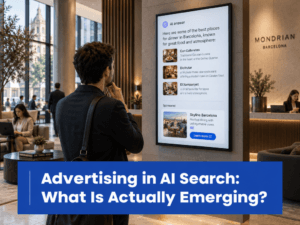
Another area of commercial development concerns advertising and monetisation. As AI Search becomes an independent channel through which people obtain information, platforms and advertisers are beginning to explore ways of incorporating commercial offers, recommendations and sponsored formats. These models take different forms, but interest in them demonstrates that AI Search is already being treated not only as a technological capability, but also as a distinct part of the digital economy.
Together, these developments show that AI Search already has a substantial professional ecosystem. It includes education, services, tools, employment, consulting models and commercial experimentation. Different areas use their own terminology and methods, but they address the same established practical challenge: how to be found, represented and selected within the new search environment.
AI Search Is Changing the Relationship Between Platforms, Sources and Society
AI Search is changing not only how users obtain information, but also the relationships between platforms, sources, publishers and other participants in the information environment.
When a system generates a complete answer, it decides which materials to use, which facts to include, which sources to display and how prominently those sources should be presented. This gives the platform a more active role: it now selects, interprets and presents information itself, rather than simply directing users to external pages.
For website owners, authors and publishers, this creates new questions. A source may be used in the generation of an answer without receiving a prominent mention or a visit from the user. Even the presence of a citation does not guarantee that the user will notice or open the original source. As a result, the traditional relationship between producing content, being discovered and receiving an audience is changing.
This leads to a broader question about how value is distributed. The platform can use information to create its own answer, the user receives a ready-made result, and the original source may receive less direct attention than it would through other forms of discovery. This is already affecting relationships between technology companies and publishers, including discussions about licensing, compensation and the conditions under which content may be used.⁴
AI Search has also become part of wider debates about copyright and the permissible use of protected material. Legal proceedings, licensing agreements and negotiations between platforms and rights holders demonstrate that this is not only a technical development. It also involves the redistribution of rights, responsibilities and economic value.
Questions of transparency are also emerging. Users do not always understand why a system selected particular sources, which materials were excluded or how confidently they should rely on the resulting answer. This is especially important in areas such as health, finance, law, politics and public services, where an error or incomplete explanation may have serious consequences.
The use of AI-generated answers by public institutions introduces an additional level of responsibility. When such systems respond to questions about rules, services, rights or official procedures, the requirements for accuracy, verifiability and accountability become considerably higher. An error in a commercial recommendation and an error in official public information do not have the same consequences.
AI Search is also becoming a matter of regulation and competition policy. Regulators are examining how platforms use data and content, how transparent source-selection mechanisms are, whether certain market participants receive unfair advantages and which rights remain with the creators of information.
Taken together, these developments place AI Search inside a broader system of relationships — between those who create information, those who process and present it, and those who act on it.
Different Regions Emphasise Different Aspects of AI Search
AI Search is developing as a global phenomenon, but the issues that receive the most attention vary according to legal systems, languages, market structures and local information environments.
In Europe, much of the discussion concerns regulation, competition and publishers’ rights. Particular attention is being given to how major platforms use content, the conditions under which they gain access to data and the changing position of publishers and other information providers. AI Search is therefore being treated not only as a technological innovation, but also as part of the wider digital economy, in which transparency, fair conditions and the distribution of market power all matter.
In the United States, competition between platforms, legal proceedings, the commercial value of AI visibility and new monetisation models play a prominent role. Companies are trying to understand how appearing in AI-generated answers affects brands, traffic, sales and audience behaviour. At the same time, litigation and negotiations with rights holders are shaping the practical boundaries of content use.
In parts of the Asia-Pacific region and the Middle East, other priorities are also visible. AI Search development is often connected with government digital services, national language models, sovereign AI initiatives and efforts to create systems that work more effectively with local languages, laws and sources. In these projects, AI Search may be treated not only as a commercial product, but also as part of national digital infrastructure.
Language matters in every region. The quality of AI Search depends on how well a language is represented online, how many reliable local sources exist, whether official data is accessible and how accurately systems understand local context. The same type of query may therefore produce answers of very different quality depending on the language and country involved.
Legal priorities also differ. Some jurisdictions focus on copyright and licensing, while others place greater emphasis on competition, transparency, data access or platform accountability. These differences do not change the fundamental nature of AI Search, but they do shape the conditions under which it develops and is applied.
The regional picture demonstrates that AI Search has already become an international field involving not only global technology companies, but also national governments, local markets, linguistic communities and legal systems. Its future development will be determined by the interaction between global technologies and local conditions.⁵
Conclusion
By mid-2026, AI Search has secured a visible position in research, professional practice and commercial activity, and it sits at the intersection of information retrieval, artificial intelligence, marketing, media, law and the digital economy without belonging fully to any one of them.
What moves this from an application of AI to a field in its own right is the direction of the traffic between its parts. Research findings are turning into optimisation methods; those methods are turning into services, tools and job titles; accumulated practice is entering university and professional courses; and questions that began as technical — how a system selects and represents a source — have become commercial, legal and political ones, visible in EU competition proceedings, publisher licensing deals and national AI-infrastructure projects alike.
One question remains open even as the field continues to develop: who captures the value it generates. As platforms take on a more active role in selecting and presenting information, the position of the sources they draw on, and of the public institutions and users who rely on the results, is still being negotiated rather than settled. That negotiation is one of several forces — alongside continuing technical development, regulation and shifts in how different regions apply AI Search — that will shape how the field looks by the end of the decade.
Notes
The notes below provide examples of sources and materials supporting the article’s main arguments. They do not represent the complete bibliography of the wider research project.
1. AI Search as an Information System and Field of Research
Characterizing Web Search in the Age of Generative AI; The Rise of AI Search: Implications for Information Markets and Human Judgement at Scale; Measuring Google AI Overviews: Activation, Source Quality, Claim Fidelity, and Publisher Impact; The Attribution Crisis in LLM Search Results; XRAG: Cross-lingual Retrieval-Augmented Generation.
2. Education and the Transfer of Professional Knowledge
Search and AI Engine Optimization — University of California, Santa Cruz Extension; Generative Engine Optimization Specialization — Coursera; Google’s Guide to Optimizing for Generative AI Features on Google Search; AI Visibility Toolkit Crash Course — Semrush Academy.
3. Professional Practice, Tools and the Labour Market
GEO: Generative Engine Optimization; Google’s Guide to Optimizing for Generative AI Features on Google Search; Ahrefs Brand Radar — AI Search Visibility Monitoring; Semrush AI Visibility Toolkit; Senior Manager, AI Search & Discovery — Insurify.
4. Publishers, Copyright and Platform Relationships
European Commission Investigation into Google’s Use of Publishers’ Content for AI; Impact of AI Search Summaries on Website Traffic; The Attribution Crisis in LLM Search Results; Le Monde and Perplexity Partnership; UK Government Report on Copyright and Artificial Intelligence.
5. Regulation, Public-Sector Projects and Linguistic Contexts
European Commission Proceedings on AI Chatbot Access to Google Search Data; SearchSG — AI-powered Search Across Singapore Government Websites; GPT-Legal and the AI-powered Search Engine in LawNet; U-Ask on UAE Government Portals; Singapore National Multimodal LLM Programme; XRAG: Cross-lingual Retrieval-Augmented Generation.
Research note: This article is based on an ongoing OZZOU research project focused on AI Search. The project draws on hundreds of materials, including academic research, professional publications, educational initiatives, market and employment data, regulatory documents and public-sector projects. The article presents only the part of the collected material that directly relates to its central question.